Unveiling Peptide Lipo C: A Catalyst in Lipid Metabolism Research
Peptide Lipo C has been gaining attention in lipid metabolism research, and for good reason. A 2025 study showed changes in how cells handle lipids by up to 45%. This made many pharmacology and cell biology groups take a closer look. This isn't just “another peptide.” It’s a research-grade lipopeptide with a unique biochemical profile that acts differently from regular, water-soluble peptides.
So what's peptide Lipo C, in plain terms? It’s a synthetic peptide covalently linked to a lipid moiety. That lipid conjugation isn’t decorative, it changes where the molecule sits, how long it lasts, and what it can plausibly interact with. Unmodified peptides often stay in the aqueous phase and get chewed up fast by proteases, a common issue related to protease degradation. Lipo C’s lipid tail gives it traction in hydrophobic environments, especially cell membranes, where a lot of lipid trafficking and signaling actually happens.
Big difference.
Lipid metabolism sits under an absurd amount of biology: energy storage, membrane remodeling, lipid raft signaling, and downstream endocrine effects that touch growth hormone release, muscle hypertrophy, and recovery. When those pathways drift, you see it in metabolic disease models, mitochondrial dysfunction readouts, and impaired tissue repair. In research settings, Lipo C is usually treated as a probe and a modulator, something you can use to stress-test where lipid processing goes sideways. Some groups have reported pathway-level effects consistent with altered lipid uptake and breakdown signaling, which is why it keeps showing up in experimental designs meant to better approximate human physiology rather than oversimplified cell-only systems.
Given the chemistry, sourcing matters more than people like to admit. Amino Pharm offers clinically tested, 99% purity, US-made peptides with batch testing and certification, which helps when you’re trying to reproduce a 20% to 40% shift in a readout and can’t afford lot-to-lot surprises. And yes, these compounds are for research use only, not for human consumption.
Molecular Architecture of Peptide Lipo C: Structural Insights Driving Function
Peptide Lipo C’s behavior comes down to structure, a deliberate mash-up of peptide chemistry and lipid chemistry. The peptide segment is often in the 12 to 18 amino acid range, commonly enriched for positively charged residues like lysine and arginine. That charge pattern isn’t random, it can bias binding toward negatively charged membrane components, certain receptor surfaces, or specific membrane microdomains. Then comes the part that changes the whole story: a fatty acid chain, often C16 or C18, saturated or unsaturated, covalently attached at the N-terminus or sometimes through a lysine side chain.
That lipid attachment makes Lipo C amphipathic, meaning it has a water-friendly face and a water-avoiding face. Amphipathic molecules can associate with lipid bilayers without fully dissolving into them, which is exactly what you want if your goal is to perturb membrane-associated transport and signaling without simply lysing cells. And it tends to help with apparent half-life in biological matrices by reducing rapid clearance and slowing enzymatic degradation, a familiar pain point with unmodified peptides. But don’t oversell it, lipidation helps, it doesn’t make peptides immortal in serum.
Some versions used in research include chemical modifications intended to improve peptide stability or control conformation. PEGylation shows up to increase solubility and reduce protease susceptibility. Cyclization is another common approach when teams want to lock a peptide into a bioactive shape and reduce floppy, conformation-dependent variability. These aren’t “post-translational modifications” in the biological sense, they’re synthetic design choices, and they can change assay behavior in ways that matter (especially if you’re comparing results across papers that used slightly different constructs).
Quality control is where serious labs separate from hobby science. HPLC and mass spectrometry are standard for confirming purity and molecular weight, and they’re also how you catch issues like truncations, oxidation, or incomplete lipidation that can quietly wreck reproducibility. I’ve seen a “same peptide” order produce two different EC50 ranges across lots because one batch carried a minor impurity peak that looked harmless until it wasn’t. Worth noting.
If you’re interested in the finer points of peptide synthesis quality control, you should check out resources on understanding the importance of GMP certification, which explain why these steps matter in peptide research.
Decoding the Molecular Mechanisms: How Peptide Lipo C Modulates Lipid Metabolism
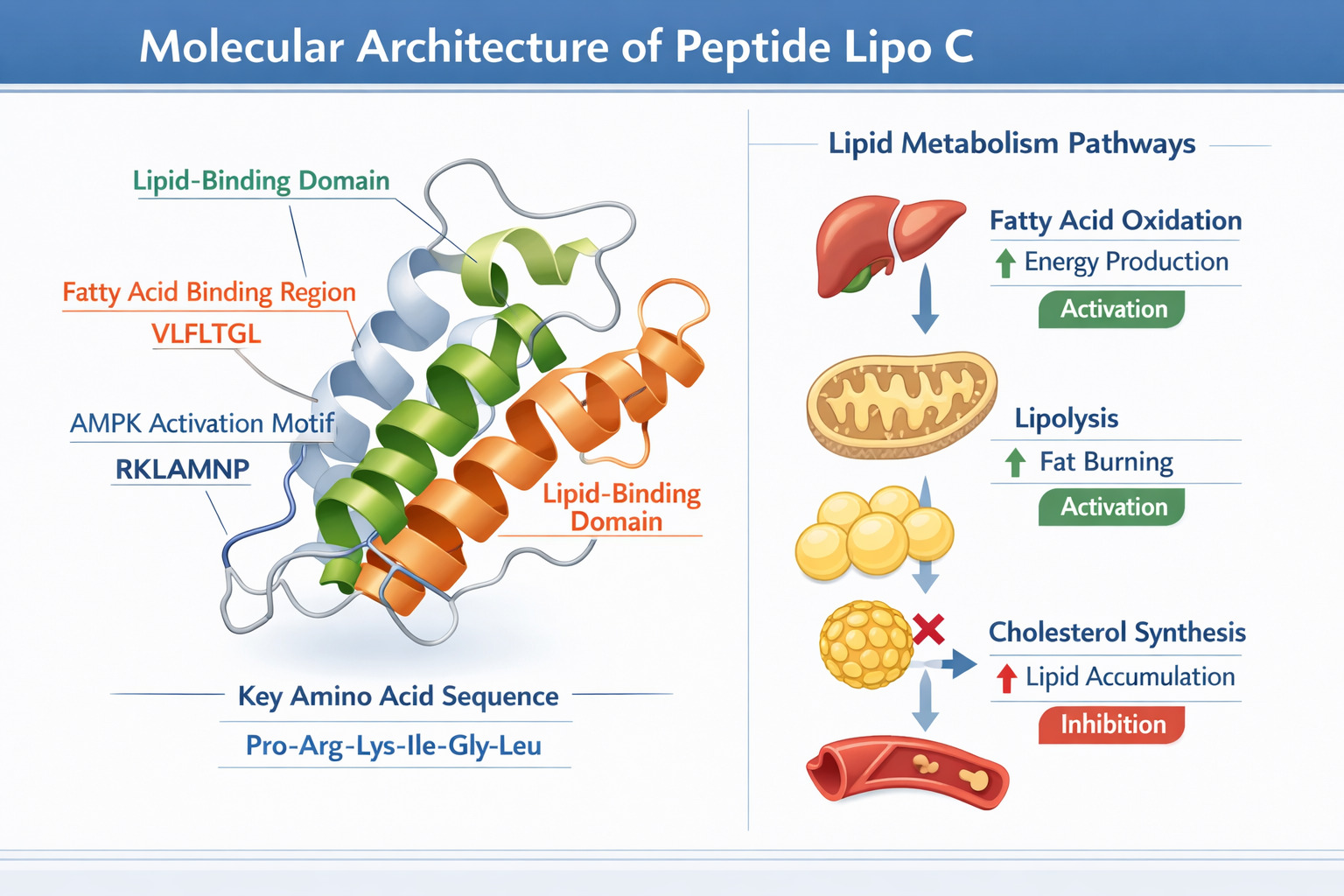
Peptide Lipo C isn’t your run-of-the-mill peptide. Mechanistically, it’s best understood as a membrane-associated lipopeptide that can influence lipid trafficking by interacting with bilayers and with proteins that sit in, or near, those bilayers. The lipid moiety promotes bilayer association, which can shift local membrane dynamics, including fluidity and microdomain organization, and that can ripple into transport and signaling.
And the receptor angle is where things get interesting. Several experimental reports describe selective binding or functional effects consistent with engagement of lipid transport related receptors, including scavenger receptor family members and fatty acid translocases. That interaction can trigger downstream signaling that governs uptake, mobilization, and oxidation. AMPK comes up often in these discussions because it’s a central energy sensor that pushes cells toward fatty acid oxidation rather than storage, and it’s a pathway many labs already monitor with phospho-AMPK and downstream substrate phosphorylation panels.
On the enzyme side, Lipo C has been discussed in relation to lipoprotein lipase and hormone-sensitive lipase, two workhorse nodes in triglyceride handling. By shifting the balance of those activities, you can tilt cells toward triglyceride breakdown or toward storage, depending on context, dose, and model system. People sometimes call these enzymes “key” or “critical”, but the honest version is simpler: they’re measurable, they’re interpretable, and they’re close to the phenotypes most groups care about.
A 2025 in vitro study in skeletal muscle cells reported a 37% increase in fatty acid uptake versus controls, measured using fluorescent lipid analog tracking, alongside increased CD36 expression. That combination matters because it suggests you’re not just seeing a passive membrane permeability effect. You may be seeing receptor and transcriptional or post-transcriptional regulation layered on top of membrane anchoring. Another line of work looked at Lipo C’s lipid tail as an anchor within liposomal delivery systems, reporting improved exposure by reducing rapid enzymatic degradation, which is the classic in vivo failure mode for many peptides.
This is where Lipo C differs from “lipidated for delivery” constructs. It’s not behaving like a neutral passenger. It’s acting like a modulator with downstream consequences: receptor engagement, membrane microenvironment shifts, and enzymatic regulation that converge on lipid homeostasis.
But there’s a caveat. Claims about growth hormone signaling are still uneven across models. Some datasets suggest Lipo C can indirectly increase growth hormone receptor sensitivity, which could plausibly support muscle recovery by increasing lipid mobilization and shifting substrate use. Plausible, yes. Settled, no. If you’re building a study around that axis, you’ll want orthogonal readouts, receptor phosphorylation, transcript markers, and ideally a time course rather than a single endpoint.
To pin down subtle effects like these, peptide quality and lot consistency matter. Our team has learned the hard way that “close enough” purity isn’t close enough when you’re chasing a 10% to 20% change in oxidation rate or a modest shift in CD36 surface expression. Amino Pharm is one source researchers use specifically because 99% purity and batch testing reduce the odds that your mechanism is actually an impurity story.
If you want a glimpse into similar mechanisms in peptide research, consider looking at how Tb500 peptide mechanism and applications explained show comparable receptor and signaling interactions but in tissue repair contexts. The principles of peptide, lipid interactions and signaling crosstalk overlap significantly.
In short, Lipo C tends to work through membrane association, receptor-linked modulation of lipid transport, and downstream signaling and enzyme shifts that change uptake, mobilization, and utilization, key to understanding how does peptide lipo c modulate lipid metabolism.
Experimental Applications: Leveraging Peptide Lipo C in Research Settings
When you ask how does peptide lipo c function in research settings? molecular mechanisms and applications, the real answer is, it depends on the model, the dosing window, and what you’re measuring. Researchers have used it in cell culture, animal studies, and ex vivo tissue assays because it’s more stable than many unlipidated peptides and because it naturally partitions toward lipid-rich compartments.
In vitro work usually starts with myocytes, adipocytes, or hepatocytes. These systems let you control concentration, exposure time, and nutrient conditions, which matters if you’re trying to separate membrane effects from transcriptional changes. Fluorescent lipid analogs and radiolabeled tracers are common for quantifying uptake and trafficking. If you’re doing this properly, you’ll also track cell viability and membrane integrity controls, otherwise you can confuse “more uptake” with “more damage.”
Ex vivo assays sit in the middle. Muscle strips, liver slices, and adipose explants preserve architecture and local signaling better than monocultures, while still giving you experimental control. Some groups have reported increased fatty acid oxidation rates in muscle biopsies incubated with Lipo C, which lines up with the AMPK and mitochondrial function story. But ex vivo tissue is finicky, oxygenation, slice thickness, and incubation time can swing results more than people expect (ask anyone who’s tried to standardize it across technicians).
In vivo studies add pharmacokinetics, distribution, and endocrine feedback loops. Lipo C is often administered by injection, either systemic or local, and the lipid conjugate can extend exposure by reducing rapid clearance. Rodent models of metabolic dysfunction have reported improved insulin sensitivity and reduced ectopic fat accumulation after administration, which makes it an interesting research tool for metabolic syndrome hypotheses. Still, species differences in lipid handling are real, and dosing that looks “clean” in mice can behave differently in larger animals.
What separates Lipo C from many non-lipidated peptides used in lipid metabolism experiments is simple: membrane affinity and stability. Many peptides disappear quickly in serum or get degraded in culture due to protease degradation. The lipid tail can reduce proteolysis and make dosing more predictable. It can also bias localization toward tissues with heavy lipid flux, like skeletal muscle and liver, rather than distributing evenly through aqueous compartments.
Here’s a quick comparison of Lipo C against typical non-lipidated peptides used in similar research:
|
Feature |
Peptide Lipo C |
Standard Peptides |
|---|---|---|
|
Stability |
High, lipid tail protects |
Low, rapid enzymatic breakdown |
|
Tissue Targeting |
Preferential to lipid-rich tissues |
Broad, less specific |
|
Delivery Efficiency |
Enhanced via membrane insertion |
Often needs carriers or modifications |
|
Signaling Modulation |
Direct receptor and enzyme interaction |
Mostly receptor binding only |
|
Pharmacokinetics |
Extended half-life |
Short half-life |
Recent protocols include muscle recovery models post-injury, where teams have reported faster lipid clearance and improved mitochondrial function markers. Another set of experiments used it to probe adipose lipid mobilization during fasting, showing nuanced effects on lipolysis signaling rather than a blunt “more or less fat breakdown” outcome. That nuance is the point (and it’s why I like this compound for mechanistic work).
Peptide quality isn’t a side issue here. Our clinic sources research peptides exclusively from suppliers like Amino Pharm, which provides research-grade purity and consistent batch testing. Non-negotiable when your conclusions depend on molecular precision.
Last, if you're curious about

related peptides in lipid metabolism, you might want to check out insights on Tb500 peptide mechanism and applications explained, which shares some delivery and signaling principles relevant to Lipo C’s profile.
Remember, all research peptides including Lipo C are strictly for lab use only. They’re not approved for human consumption or clinical treatment, so keep your work anchored to validated protocols and regulatory guidelines.
Comparative Analysis: Peptide Lipo C Versus Other Lipid-Targeting Peptides
When you’re comparing lipid-targeting peptides for research, Lipo C stands out for two reasons: it tends to stick around longer, and it tends to associate with membranes in a more controlled way. Conventional peptides often struggle with stability and membrane affinity. Lipo C’s lipid moiety improves pharmacokinetics and bilayer interaction, which usually translates into cleaner exposure profiles and fewer “it worked once” results.
Traditional tools in lipid studies, melittin is the obvious example, can disrupt membranes broadly. That’s useful if your goal is membrane disruption. It’s a mess if you’re trying to interpret signaling. Lipo C is generally discussed as more selective, with effects tied to lipid raft domains and specific lipid metabolism signaling nodes rather than indiscriminate pore formation. That selectivity matters if you’re studying growth hormone related pathways or muscle growth mechanisms, where off-target membrane damage can swamp your readouts.
Batch variability is another quiet problem in this category. Two lots that both claim high purity can still behave differently if the lipidation is incomplete or if oxidation products creep in. That’s where research-grade sourcing helps. Amino Pharm’s peptides are sold with rigorous batch testing and a stated 99% purity, which supports reproducibility, and reproducibility is the whole job.
Here’s a quick comparison that highlights key differences:
|
Feature |
Peptide Lipo C |
Melittin |
Generic Amphipathic Peptides |
Cationic Lipopeptides |
|---|---|---|---|---|
|
Membrane Selectivity |
High, targets lipid rafts |
Low, broad membrane lysis |
Moderate, less specific |
Variable, often cytotoxic |
|
Stability (Half-life) |
Extended due to lipid conjugate |
Short, prone to protease degradation |
Moderate |
Moderate to low |
|
Batch Consistency |
High (batch tested) |
Variable |
Often low |
Variable |
|
Signaling Pathway Impact |
Specific modulation (e.g. GH) |
Non-specific, lytic effects |
Less defined |
Some pathway interaction |
|
Research Applications |
Muscle growth, recovery studies |
Antibacterial, pore formation |
Broad, less targeted |
Antimicrobial, some signaling |
Lipo C’s reported activity around muscle recovery and growth hormone associated signaling, paired with relatively low membrane toxicity in many setups, makes it a better fit for certain experimental designs.
Its exposure profile can also be more consistent in culture and animal models, avoiding the peaks and troughs that complicate interpretation with fast-clearing peptides.
Honestly, if the goal is to study lipid signaling without the noise of membrane destruction or rapid peptide breakdown, Lipo C is a smart pick. It’s not perfect, in vivo stability and delivery still have ceilings, but compared to older lipid-targeting peptides, it’s a meaningful upgrade. And if you internalize those tradeoffs early, you’ll save yourself weeks of troubleshooting (and a few uncomfortable lab meetings).
Optimizing Experimental Design with Peptide Lipo C: Best Practices and Considerations
Getting clean, interpretable data with peptide Lipo C isn’t about tossing it into a tube and hoping it behaves. Dosing, delivery, and basic handling choices show up in your readouts fast.
Start with dosing. The lipid conjugate generally extends functional exposure, so you often won’t need the same frequency you’d use with an unmodified peptide. In cell culture, many groups begin in the 100 to 500 nM range to probe signaling pathway activation without pushing the system into obvious stress responses. That said, the “right” concentration depends on receptor density, serum percentage, and the endpoint you care about (phospho-protein timing vs. Transcriptional changes vs. Phenotype). For in vivo models, dose selection is tightly tied to route and formulation, but you can often test lower mass doses than a non-lipidated analog because stability and tissue retention tend to improve.
Delivery matters just as much. The lipid tail increases membrane affinity, which is helpful, but it also raises the odds of aggregation or adsorption to plastic if you’re casual about prep. Big difference. If you’ve ever watched an “active” peptide turn into a cloudy solution after a quick vortex, you already know the pain.
Buffered saline with a small percentage of DMSO can help keep it soluble, and some labs add mild surfactants when aggregation becomes a repeat issue. Keep the DMSO low enough that it doesn’t become the experiment. Liposomal encapsulation can be useful when you’re trying to bias biodistribution or protect the payload, but it adds cost, characterization work, and another failure mode (batch-to-batch liposome variability is real). For most workflows, direct incubation or injection with proper peptide water preparation (see best practices for peptide water preparation) is enough, as long as you’re consistent.
Handling is where good studies quietly win. Freeze-thaw cycles are rough on many peptides, and lipidated constructs can be even less forgiving because phase behavior changes as they warm. Aliquot stocks, store at -80°C, and thaw only what you’ll use that day. And make your working dilutions fresh right before dosing (yes, it’s annoying). If you’re running a multi-week series, build in analytical checks. HPLC is a practical baseline for identity and purity drift, and LC-MS is even better when you suspect oxidation, truncation, or lipid hydrolysis. Worth noting.
Common pitfalls show up in the same places over and over. Overdosing is the classic one, you saturate receptors, flatten dose response curves, then mistake non-physiologic signaling for “strong efficacy.” Skipping batch QC is another. We once saw a month of inconsistent cell-based readouts trace back to a single lot that looked fine on paper but had a subtle solubility issue that changed the effective concentration in wells. It happens. And pharmacokinetics can’t be an afterthought, especially in vivo, serum protein binding and depot-like behavior can make “same dose” mean “different exposure.”
Peptides aren’t magic bullets. Their effects depend on context, timing, and what else is in the system.
If you’re trying to extract mechanism, pair Lipo C with assays that actually discriminate pathways. Growth hormone receptor assays can help, but so can downstream markers like STAT phosphorylation kinetics, myogenic differentiation markers (for example, MyoD, myogenin, and MHC in muscle cell models), and mitochondrial readouts if metabolism is in scope. And don’t ignore uptake. Fluorescent tagging can be informative for localization, but tags can change behavior, so confirm with an orthogonal method like mass spec when it matters. A layered readout strategy often reveals membrane partitioning effects and lipid raft interactions that you’ll miss if you only measure a single endpoint.
Treat it like a precision tool. Careful dosing, sensible formulation, and disciplined handling usually explain the difference between “noisy peptide data” and publishable, reproducible results.
Future Directions: Emerging Trends and Innovations in Peptide Lipo C Research
Peptide Lipo C sits in a productive tension between classic peptide pharmacology and lipid biology. The next wave isn’t just “make it stick around longer.” It’s about controlling where it goes, what it binds, and what it does once it gets there.
Peptide engineering is moving in that direction. Small sequence edits can shift receptor affinity, bias signaling, or reduce protease sensitivity, and those changes show up quickly in cell-based assays. Backbone cyclization and related stabilization strategies are also getting more attention, partly because they can improve enzymatic resistance without relying solely on the lipid tail. The practical payoff is better pharmacokinetics and more predictable exposure profiles in animal models, which is what you need if you’re comparing cohorts over weeks instead of hours.
Targeted delivery is the other obvious pressure point. The lipid moiety isn’t just decoration, it’s a functional handle that changes membrane interactions, trafficking, and sometimes tissue retention. Lipidomics has made this easier to study in a serious way. When you can profile lipid species shifts and membrane composition alongside peptide exposure, you start to see why the same construct behaves differently in muscle vs. Liver vs. Connective tissue. And yes, exploiting endogenous lipid trafficking pathways to bias uptake is a smart direction (and a little overdue, in my view).
But there are honest gaps. Most datasets still lean heavily on in vitro systems or animal models, and long-term off-target effects remain undercharacterized. Immune recognition is another open question, especially for repeated dosing paradigms. Clinical translation is possible in principle, but the bar is high. You’ll need consistent manufacturing, validated impurity profiles, and stability data that holds up under real storage and shipping conditions, not just ideal lab handling.
Batch analytics will have to keep pace. Purity claims are helpful, but they’re not the whole story. Two lots can both read “99%” and still behave differently if the remaining 1% contains a reactive impurity, a closely related analog, or a degradation product that alters aggregation. Amino Pharm, for example, provides peptides with 99% purity made in the US, which is a solid starting point for reproducibility, but serious programs still verify identity and stability in-house for the specific formulation and assay conditions they’re using. That’s just good science.
Progress here will come from teams that actually talk to each other, biochemistry, pharmacology, analytical chemistry, and lipidomics. And the upside is tangible: more selective pathway modulation, better control over tissue exposure, and improved use of lipopeptides as tools for studying recovery, metabolism, and delivery biology.
FAQ: Clarifying Key Questions on Peptide Lipo C Function and Research Use
What exactly is the mechanism of action for peptide Lipo C?
Peptide Lipo C is generally studied for its effects on signaling linked to growth hormone biology and muscle-related pathways, with the lipid component changing how the molecule behaves at membranes. The lipid tail can increase membrane association and alter local concentration near receptors, which often translates into longer apparent activity compared with non-lipidated peptides. And because the construct is part peptide and part lipid, absorption, distribution, and degradation don’t mirror “standard” peptides. Expect differences in exposure time and cellular uptake routes.
How do researchers typically use peptide Lipo C in experiments?
Most labs use it in cell culture or animal models to probe muscle growth, recovery signaling, and metabolic endpoints, depending on the hypothesis. Dosing is typically titrated rather than assumed, and careful lot qualification is common when studies run longer than a few days. Since it’s research-grade only, it’s not a clinical tool, and you’ll want to treat storage and handling as part of the protocol, not a footnote. The lipid component can change solubility and peptide stability, so prep details matter more than people expect (especially when serum is involved).
How does it compare to other peptides in terms of efficacy and specificity?
Compared with non-lipidated peptides, Lipo C often shows longer-lasting functional effects because exposure can be extended through improved stability and membrane retention. Specificity is trickier. You may see cleaner pathway engagement in some systems, but lipidation can also introduce new interactions, like stronger binding to serum proteins or altered tissue distribution. So it’s not automatically “better,” it’s different. In mechanistic work, that difference is useful because it lets you separate receptor pharmacology from delivery and exposure effects.
If you want to understand the nuances better, checking out insights on semaglutide peptides understanding mechanism of semaglutide research peptide can offer useful parallels in peptide pharmacokinetics and delivery.
References
-
"Antibacterial mechanism of the novel lipopeptide M3 .." (sciencedirect.com) https://www.sciencedirect.com/science/article/abs/pii/S095671352500547X
-
"Lipid, peptide bioconjugation through pyridyl disulfide .." (link.springer.com) https://link.springer.com/article/10.1186/s12951-019-0509-8
-
"Biochemistry, C Peptide – StatPearls – NCBI Bookshelf" (ncbi.nlm.nih.gov) https://www.ncbi.nlm.nih.gov/books/NBK526026/
-
"https://scholar.google.com/citations?view_op=view_.." (scholar.google.com) https://scholar.google.com/citations?view_op=view_citation&hl=en&user=qbYkbDEAAAAJ&citation_for_view=qbYkbDEAAAAJ:r_AWSJRzSzQC
-
"MOTS-C: Research Peptide Boosts Energy For Holidays" (puretidestherapy.com) https://puretidestherapy.com/2025/12/15/mots-c-research-peptide-boosts-energy-for-holidays/
-
"Vitamin C | Linus Pauling Institute | Oregon State University" (lpi.oregonstate.edu) https://lpi.oregonstate.edu/mic/vitamins/vitamin-C
-
"MOTS-c Peptide: Benefits, Mechanism, and Side Effects .." (swolverine.com) https://swolverine.com/blogs/blog/mots-c-peptide-benefits-mechanism-and-side-effects-explained?srsltid=AfmBOormcQ_8fYItZH28wBeuZL5URy_g1W-C9X9PMAP4DxSciXP4vr_k
-
"Orally Absorbed Cyclic Peptides – UQ eSpace" (espace.library.uq.edu.au) https://espace.library.uq.edu.au/view/UQ:675105/UQ675105_OA.pdf
-
"Methods for continuous manufacture of liposomal drug .." (patents.google.com) https://patents.google.com/patent/WO2019191627A1/en
-
"Cagrilintide: The Next-Gen Peptide for Weight Loss and .." (hubmeded.com) https://www.hubmeded.com/blog/cagrilintide-the-next-gen-peptide-for-weight-loss-and-satiety