Why Strict Safety Protocols Are Crucial When Handling Research Chemicals and Peptides
Lab accidents involving research chemicals and peptides aren’t rare mishaps. They happen more often than people like to admit. A 2019 Chemical Safety Board report pinned roughly 25% of chemical-related lab incidents on improper handling or weak safety controls. That’s not a rounding error, it’s a pattern.
Peptides and synthetic compounds add a twist because many are biologically active at low doses. Some interact with signaling pathways tied to growth hormone release, inflammation, or muscle protein synthesis. Accidental exposure can produce real physiological effects, even when the compound looks “clean” on paper.
Health risks don’t stop at skin irritation or a cough. Certain peptides can trigger immune responses, leading to sensitization or allergic reactions after repeat exposure. Contamination is the quieter problem. Cross-contamination can wreck experimental validity, especially in preclinical work where small concentration shifts change outcomes. Picture running a pharmacokinetics study, then realizing your curve is garbage because a vial sat warm on the bench or a pipette tip touched the wrong surface. Frustrating. Expensive.
Safety protocols exist for scientific reasons, not because someone likes paperwork. FDA and OSHA guidance is built on decades of incident reports, exposure data, and hard lessons from labs that learned the painful way. Batch testing and analytical verification can confirm peptide purity, but sloppy handling can still introduce degradation products, endotoxin, or carryover. Big difference.
The mechanism of harm depends on the material. Volatile solvents can cause acute respiratory exposure. Some peptides may interfere with endocrine signaling if absorbed through skin or inhaled as fine powder. That’s why the question, what are the safety protocols for handling research chemicals including peptides, isn’t academic. It’s a day-to-day operating standard.
If your lab works with research peptides or specialty chemicals, don’t treat safety like an optional add-on. It’s the foundation of reproducible, defensible science.
Personal Protective Equipment (PPE): The First Line of Defense
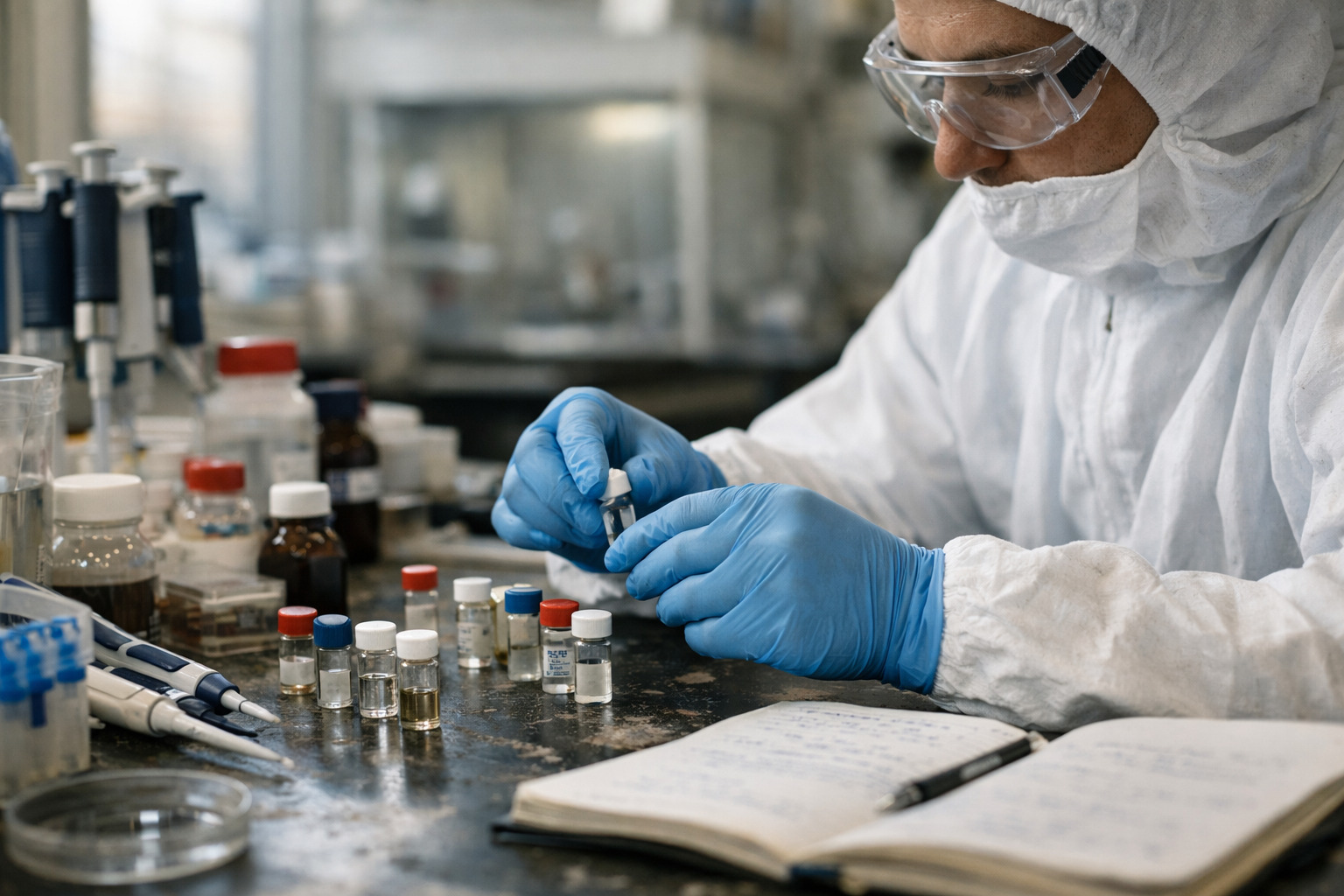
If you think PPE is just gloves and a lab coat, you’re missing the point, and taking a risk you don’t need to take. PPE is your primary barrier against dermal exposure, splashes, aerosols, and contaminated surfaces. And yes, it matters even when you’re “just weighing a little powder.”
Gloves are non-negotiable, but glove choice is where labs get sloppy. Nitrile generally resists permeation better than latex for many solvents and lab reagents, and it avoids latex allergy issues. Thickness matters, too. I’ve watched a new tech weigh a hygroscopic peptide, then realize the glove fingertips were damp and tacky within minutes because the bench had trace solvent residue. That’s how contamination spreads. If you’re handling volatile solvents, highly bioactive peptides, or unknowns, double-gloving is often the safer call. Check a chemical compatibility chart before you commit, not after.
Lab coats aren’t fashion. They’re a removable contamination boundary. Many labs stick with cotton, but cotton can hold onto residues and wick liquids. Polyester blends or coats with chemical-resistant finishes are easier to decontaminate and less likely to become a long-term exposure source. If your coat has visible staining, treat it like contaminated equipment, not laundry.
Eye protection needs to seal. Safety goggles that fit around the eyes protect against splashes, dust, and aerosols. Standard glasses don’t. Face shields are worth using during transfers, reconstitution, or any step where pressure changes and splatter are plausible (and they are, more often than people admit).
Respiratory protection gets ignored until someone smells solvent or starts coughing. Powders can aerosolize during weighing, lyophilization handling, or even opening a vial with static. Depending on the hazard assessment, that can mean a properly fitted respirator with P100 filters, or working under engineering controls so you don’t need respiratory PPE as your main control. Fit testing and training aren’t optional if respirators are part of the plan.
Donning and doffing is where “good PPE” becomes bad practice. Contaminated gloves touch notebook covers, door handles, phones, and then someone rubs an eye. It happens. Put PPE on before you handle compounds, keep hands away from your face and personal items mid-procedure, then remove gear carefully and dispose of it in the correct chemical waste or biohazard stream. Don’t reuse disposable PPE. For reusable items, follow your lab’s decontamination SOPs and document them.
Amino Pharm provides research-grade peptides with 99% purity, but purity doesn’t make a compound safe to touch. It just means you know what you’re dealing with. Our team still treats peptides as potentially hazardous until the risk assessment says otherwise.
Here’s a quick PPE checklist for handling peptides and chemicals:
| PPE Item | Purpose | Material/Specification | Notes |
|---|---|---|---|
| Gloves | Skin protection | Nitrile, 6 mil thickness or thicker | Double-glove for highly active peptides |
| Lab coat | Clothing/skin barrier | Polyester blend, chemical-resistant coating | Change between tasks to avoid cross-contam |
| Safety goggles | Eye protection | Fully sealed, ANSI Z87.1 compliant | Face shield recommended for splash risks |
| Respirator | Respiratory protection | P100 filter or better | Required during powder handling or aerosol generation |
| Handling peptides with PPE isn’t about ticking boxes. It’s about matching the barrier to the hazard, the procedure, and the exposure route. Skimp on protection and you’re gambling with your data and your health, which is a bad trade. Want to know why GMP standards matter here? The importance of GMP certification in peptide manufacturing ensures you start with a reliable product, but your PPE practices finish the job. |
And if you’re working with novel peptides, especially ones tied to recovery or muscle growth pathways, assume the unexpected until you’ve got evidence. Unknowns deserve extra caution. (Yes, even if the vial is tiny.)
For more on proper lab safety culture and chemical hygiene, check out the Laboratory Safety and Chemical Hygiene Plan (researchsafety.northwestern.edu).
Optimizing Laboratory Workspace to Minimize Exposure and Contamination

A safe workspace isn’t about being tidy for its own sake. It’s exposure control and data control, at the same time. When people ask what are the safety protocols for handling research chemicals including peptides, workspace design is usually the missing piece.
Start with zoning. Separate areas for storage, preparation, and waste. Clear boundaries reduce mix-ups, reduce cross-contamination, and make it easier to spot when something’s out of place. Keep consumables like pipette tips, wipes, and spare gloves within reach but off the main prep surface. A cluttered bench hides spills, blocks your view of vial labels, and increases the odds that a sleeve drags through residue.
Engineering controls matter more than most PPE, and that’s not a popular opinion, but it’s true. Fume hoods control vapors and airborne particulates from solvents and irritants. Biosafety cabinets protect both the sample and the worker when sterility and aerosol containment are the priority. If you’re weighing peptide powders, reconstituting lyophilized material, or handling anything that can become airborne, work under the right hood or cabinet. Get the unit certified annually, and learn the airflow pattern. Blocking the front grill with a notebook or waste container is a classic rookie move, and it defeats containment.
Cleaning can’t be casual. Wipe down surfaces with 70% isopropanol before and after each session, and use an appropriate detergent or decon agent when the hazard calls for it. Peptides can adsorb to surfaces, pick up moisture, and degrade. Residual compounds on a balance pan or spatula can carry into the next sample and quietly distort results. Worth noting.
Waste handling needs the same discipline. Don’t toss peptide vials or chemical containers into regular trash. Use designated, labeled chemical waste and biohazard containers, and don’t mix streams because it’s “just a little.” I’ve seen a lab lose weeks of work after a minor spill turned into a cross-contamination chain, all because someone used the wrong bin and the cleanup was incomplete.
But none of this works if hand hygiene is an afterthought. Even trace residues can transfer from glove to skin during removal, or from skin to shared equipment. If you want a practical upstream control that helps keep benches clean, the best practices for peptide water preparation guide is a solid place to start.
Safe Storage Practices: Maintaining Integrity and Reducing Risks
Storage isn’t just “keep it cold and out of the light.” It’s stability, traceability, and hazard reduction in one system. Temperature, humidity, and light exposure can change peptide integrity, and degraded material doesn’t just undermine potency, it can create impurities that behave differently in assays.
Many research-grade peptides are best stored at -20°C or colder, sealed tightly to limit moisture exposure. Some labs go to -80°C for longer-term stability, depending on sequence, formulation, and how often vials are opened. If you’re opening the same vial repeatedly, you’re inviting condensation and freeze-thaw stress. Aliquoting is boring, but it works.
Humidity is the sneaky culprit. Water vapor can drive hydrolysis and aggregation, especially in hygroscopic powders. Use desiccants where appropriate, keep vials sealed, and don’t leave them uncapped “for just a minute.” Light is another quiet degrader. UV and even strong fluorescent lighting can break down sensitive compounds. Amber vials or opaque secondary containers help, and so does storing light-sensitive materials in a closed box inside the freezer.
Segregation is non-negotiable. Store incompatible chemicals separately, acids away from bases, oxidizers away from organics, and peptides away from volatile or reactive reagents that could contaminate packaging or storage surfaces. Labeling needs to support traceability. At minimum, include compound name, batch or lot number, concentration (if reconstituted), purity level, date received, storage condition, and expiration or retest date. That’s not bureaucracy, it’s how you defend your data later.
Inventory management software can save you from preventable mistakes. It tracks lots, locations, expiration dates, and retest triggers, which matters when you’ve got multiple peptide sequences and several solvents in rotation. It also supports compliance with chemical hygiene plans and internal audits. Peptides from trusted sources like Amino Pharm typically ship with certificates of analysis supporting 99% purity, but storage is on you. A COA can’t stop hydrolysis.
K

eep storage areas clean and ventilated, and don’t ignore dust. Airborne contamination can settle on vial threads and seals, then end up in your sample the next time you open it. If you’re running growth hormone or muscle recovery studies, degraded or contaminated material can shift biological readouts enough to send you chasing false conclusions. For more on handling liquids correctly, explore best practices for peptide water preparation.
What’s the point of sourcing high-quality peptides if storage habits ruin them?
Reconstitution and Handling Procedures to Ensure Safety and Accuracy
Reconstituting peptides and research chemicals isn’t “add liquid, swirl, done.” It’s a controlled step that affects concentration accuracy, sterility, stability, and exposure risk. And it’s one of the easiest places to introduce error.
Start with the certificate of analysis. It tells you what you actually received, including purity, identity confirmation, and sometimes recommended solvents or storage notes. Skipping the COA is a rookie mistake, and it can lead to wrong concentrations, incompatible solvent choices, or unsafe assumptions about what’s in the vial.
Before opening a frozen vial, let it equilibrate at room temperature for about 15 to 30 minutes so condensation doesn’t form inside the container. Sudden temperature shifts can pull moisture into the vial, which is a fast way to compromise stability. Wipe the exterior with 70% isopropanol before opening. Simple step. Huge payoff.
Use sterile technique throughout. Work in a biosafety cabinet or appropriate hood, wear powder-free nitrile gloves, and use sterile syringes, needles, or pipette tips. Don’t shake vigorously. Agitation can shear delicate peptide structures or promote foaming, which makes accurate volume handling harder and can change functional performance in signaling assays. Gentle swirling or slow inversion is usually enough.
Aerosols are an underrated hazard. Pouring too quickly, snapping a pipette tip out of a vial, or expelling air through a needle can generate fine droplets. Those droplets land on surfaces, gloves, and sometimes faces. Slow, controlled pipetting reduces aerosol formation and improves dosing accuracy.
Verification matters when the study demands it. If concentration accuracy is central to your pharmacokinetics or dose-response work, confirm post-reconstitution concentration and integrity using appropriate analytical methods such as HPLC or mass spectrometry. Honest caveat, not every lab has that instrumentation in-house, so plan for validated calculations, careful documentation, and, when possible, third-party confirmation for critical studies.
Reconstitution is about accuracy, but it’s also about safety. Treat peptides and specialty chemicals as hazardous until your risk assessment and SDS data say otherwise. Using research-grade peptides from reliable suppliers like Amino Pharm reduces uncertainty about identity and purity, but it doesn’t remove the need for disciplined handling.
Waste Disposal Protocols: Minimizing Environmental and Health Hazards
Disposing of research chemicals and peptide waste isn’t something you want to wing. Improper disposal can contaminate the environment, expose staff to hazardous materials, and trigger regulatory penalties that are very real. The first step is simple, but it’s where labs most often slip up: classify the waste correctly. Peptide waste can fall under biohazardous waste, hazardous chemical waste, or sometimes both, depending on toxicity, biological activity, solvent system, and how it was used. Non-reactive peptides with no clinical or human use claim are often managed as chemical waste, but growth hormone analogs and other bioactive sequences may require tighter controls, especially if they’re handled in a way that creates exposure risk.
Containment matters. A lot. Use clearly labeled, sealable containers that match the waste stream and the container compatibility, for example, glass for many organic solvents, compatible plastics for aqueous waste (your EHS team will usually specify HDPE vs polypropylene). Labels should include contents, approximate concentration, hazard class, and accumulation start date. If you’re generating mixed waste, say a peptide in an organic solvent with a corrosive component, don’t guess which category “wins.” Ask. Misclassification is one of those mistakes that looks minor until an auditor is standing in your doorway.
Some waste needs pretreatment. Neutralization may be required for acids, bases, or reactive materials before pickup or disposal, but only when your institution allows it and only with documented procedures. A classic example is neutralizing dilute hydrochloric acid with sodium bicarbonate to reduce corrosivity. That said, neutralization isn’t a free-for-all, it can generate heat, gas, and splatter, and it can create incompatible byproducts if the waste stream isn’t what you think it is. Check your lab’s chemical hygiene plan and any site-specific EHS guidance before anyone starts “fixing” waste at the bench.
Most labs rely on licensed hazardous waste vendors or institutional pickup programs, and that’s usually the right call. Incineration is common for certain organic wastes and contaminated disposables that can’t be recovered or safely treated on-site. Liquid chemical waste may go to approved waste treatment systems, but it should never go down the sink unless your written policy explicitly permits that specific material at that specific concentration. If your policy isn’t written down, assume it’s not allowed. I’m opinionated on this point because I’ve seen too many “everyone does it” habits turn into reportable incidents.
Documentation isn’t busywork, it’s the evidence trail. Maintain logs that capture waste type, approximate quantity, container ID, accumulation date, and final disposal method. During inspections, those details are what separate a controlled program from a lab that’s improvising. Certain peptides may also require additional reporting if they have pharmacological activity, are regulated as controlled substances, or are tied to special institutional approvals. Worth noting.
Cutting corners here doesn’t just risk health and the environment, it damages your research credibility. Review How to Handle Research Compounds Safely (maxedoutcompounds.com) for a practical overview that aligns well with what most EHS programs expect.
If you work with peptides regularly, learn to read a peptide certificate of analysis like you mean it. Impurity profiles, residual solvents, counterions (TFA vs acetate), and stability notes can change how you segregate waste and what you flag for special handling. That skill pays off later (and yes, it saves money).
Training, Documentation, and Cultivating a Culture of Safety in Research Labs
Lab safety isn’t just gloves and goggles. It’s training, repetition, and a shared expectation that people speak up when something looks off. Initial onboarding helps, but it won’t carry a team for long. Labs handling research chemicals, including peptides, should run recurring refreshers and competency checks, especially for high-risk tasks like reconstitution, weighing lyophilized powders, and solvent transfers. People forget details. People get comfortable. That’s when mistakes happen.
SOPs are the backbone. They should spell out how to receive, label, store, aliquot, transport, and dispose of research-grade compounds, plus what to do during spills or suspected exposure. But an SOP that lives in a binder and never changes is basically a prop. Good labs revise SOPs when methods change, when a new analytical technique is introduced (HPLC conditions, LC-MS confirmation, endotoxin testing), or when stability data shifts the storage plan. Peptides are sensitive to temperature cycling, moisture, and adsorption to surfaces, so even small procedural updates can prevent a lot of silent failures.
Record-keeping is where rigor shows up. Batch IDs, COAs, reconstitution solvent, final concentration, aliquot size, storage temperature, freeze-thaw count, and expiration dating should be traceable. If that sounds like overkill, consider how often peptide work hinges on subtle dose response differences. A 10 percent concentration error from a transcription slip isn’t “close enough,” it’s a different experiment.
A proactive safety culture means near-misses get reported without blame. I remember a lab where a junior tech noticed condensation forming inside a secondary container holding peptide vials, but kept quiet because they didn’t want to look inexperienced. The vials cycled through warm and cold conditions over a weekend, and the team later traced an unexpected assay drift back to that event. Two weeks of troubleshooting, a pile of wasted reagents, and a lot of uncomfortable meetings. One comment on Friday would’ve prevented it. Big difference.
Leadership has to model the behavior. If the PI rushes PPE or shrugs off labeling, the rest of the team will follow. And if you want a practical standard to benchmark against, your institutional chemical hygiene plan is the starting point, for example, Laboratory Safety and Chemical Hygiene Plan (researchsafety.northwestern.edu).
Our team tends to use digital inventory tracking alongside physical logs, because each system catches what the other misses (and because printers fail at the worst possible time). The goal is boring consistency. When everyone knows exactly what “good” looks like, from the PI to the newest intern, the lab runs safer and the data hold up better.
Common Pitfalls and Real-World Examples of Safety Lapses in Peptide Research
Peptide safety incidents happen more often than most teams admit. One common error is underestimating how fast peptides can change when storage conditions drift. A 2023 preclinical program I reviewed had a batch stored in a unit with temperature swings that weren’t caught until the monitoring log was checked. The downstream effect was ugly: degraded material, noisy signaling pathway readouts, and a two-month delay while the team requalified the lot and repeated key assays. Cold-chain management isn’t “nice to have,” it’s part of experimental control. Humidity control and minimizing freeze-thaw cycles matter too, especially for small aliquots and hygroscopic lyophilized powders.
And PPE compliance still trips people up. I once saw a researcher skip gloves while handling a growth hormone peptide because they were “just doing a quick transfer.” A small spill led to skin exposure and an allergic reaction. That’s the obvious harm. The less obvious one is cross-contamination, which can spread to notebooks, balances, pipettes, and shared surfaces. If your lab handles potent bioactive materials, engineering controls like a fume hood or biosafety cabinet (as appropriate to the hazard assessment) should be part of the plan, not an afterthought.
Documentation failures are quieter, but they’re just as damaging. If batch testing results, impurity notes, or stability observations aren’t logged correctly, you can’t verify what was actually used. That’s a fast track to irreproducible results, and it’s avoidable. A simple second-person check on labeling and entries, especially when aliquots are made, catches a surprising number of errors.
| Common Pitfall | Consequence | Preventive Measure |
|---|---|---|
| Improper storage (temp/humidity) | Peptide degradation, invalid data | Strict cold storage, humidity control |
| Skipping PPE or ventilation | Exposure, allergic reactions | Mandatory PPE, ventilation systems |
| Poor documentation | Data loss, contamination | Detailed batch testing logs |
| Here’s the blunt truth: safety lapses don’t just hurt people, they distort outcomes. With sensitive compounds like peptides, small handling errors can derail months of work. For example, interpreting studies that discuss the optimal ratios for BPC 157 and TB 500 depends on consistent preparation, clean technique, and reliable records. If you want a practical checklist-style reference, the Peptide Handling and Laboratory Safety Standards (silentfilmsjaywarren.com) is a useful starting point, just make sure you align it with your institution’s EHS requirements and local regulations. |
Frequently Asked Questions
What PPE is mandatory when handling research peptides?
When handling research peptides, wear PPE that matches the risk assessment for the material and the procedure. At minimum, that usually means disposable nitrile gloves, a lab coat, and safety glasses or splash goggles. If there’s any chance of aerosol generation (vortexing, sonicating, blowing out pipette tips, handling powders), add respiratory protection if your program requires it, and work in appropriate containment. And change gloves more often than you think you need to, especially after touching shared equipment.
How should research peptides be stored to maintain safety and stability?
Store peptides under the temperature conditions supported by stability data, typically refrigerated or frozen, and protect them from light when photodegradation is a concern. Use clear labeling that includes identity, concentration, solvent, date prepared, storage temperature, and a batch or lot ID tied back to the COA. Segregate from incompatible chemicals and keep secondary containment to limit damage from leaks or condensation (it happens). If your lab has temperature monitoring, review the logs periodically, don’t just collect them.
What are the best practices for disposing of peptide waste?
Collect peptide waste in designated, compatible containers with complete labels, then route it through your hazardous waste program. Some materials may require deactivation or neutralization, but only under approved, written procedures. Don’t put peptide waste in regular trash or down drains unless your institutional policy explicitly allows that specific waste stream. Keep disposal records, including dates, quantities, and container IDs, because inspectors will ask and you’ll want a clean answer.
How can labs promote a culture of safety around chemical handling?
Build it into routine work. Train people regularly, verify competency for high-risk tasks, keep SOPs accessible and current, and treat near-miss reporting as normal rather than embarrassing. A quick five-minute discussion after a minor spill often prevents the next one. But leadership behavior sets the ceiling, if senior staff cut corners, everyone else will too.
What are common errors to avoid during peptide reconstitution?
Common mistakes include using non-sterile tools when sterility matters, picking the wrong solvent or pH, shaking aggressively and generating aerosols, and skipping filtration or endotoxin considerations when the protocol requires them. Another frequent issue is poor technique with small volumes, which drives concentration error. Follow the manufacturer’s guidance and your SOP, use calibrated pipettes, label immediately, and document the solvent, concentration, and number of freeze-thaw cycles. That’s how you protect both the researcher and the data.
References
- "Working with Chemicals – Prudent Practices in the Laboratory" , ncbi.nlm.nih.gov , https://www.ncbi.nlm.nih.gov/books/NBK55872/
- "Guidance for Industry- Synthetic Peptides" , fda.gov , https://www.fda.gov/media/107622/download
- "How to Handle Research Compounds Safely" , maxedoutcompounds.com , https://maxedoutcompounds.com/how-to-handle-research-compounds-safely/
- "Peptide Handling and Laboratory Safety Standards" , silentfilmsjaywarren.com , https://silentfilmsjaywarren.com/peptide-handling-and-laboratory-safety-standards/
- "Laboratory Safety and Chemical Hygiene Plan" , researchsafety.northwestern.edu , https://researchsafety.northwestern.edu/safety-information/laboratory-safety-and-chemical-hygiene-plan.html
- "Research Protocols" , cosmicpeptides.com , https://cosmicpeptides.com/pages/research-protocols?srsltid=AfmBOopjtbMNGalWCyGmx3JM8kkqnF-PyRtEfES8lR61nrKvty-O7e5S
- "Ensuring a Safe Lab: Best Practices for Handling and …" , peptide24.store , https://peptide24.store/2025/11/21/ensuring-a-safe-lab-best-practices-for-handling-and-disposing-of-research-peptides/
- "Chemical Safety | Environmental Safety, Sustainability and Risk" , essr.umd.edu , https://essr.umd.edu/who-we-are/research-safety/laboratory-safety/chemical-safety
- "A Strategic Roadmap for Peptide Preclinical Studies" , labtesting.wuxiapptec.com , https://labtesting.wuxiapptec.com/2025/10/30/a-strategic-roadmap-for-peptide-preclinical-studies-3-key-stages/
- "Safety Guidelines" , ich.org , https://www.ich.org/page/safety-guidelines