The Hidden Complexity Behind Peptide Purity Variability
Most people assume research peptides are more or less interchangeable on purity. They aren’t. Independent testing and in-house lab audits routinely show a spread from “looks pharmaceutical” at 99%+ down to the mid-80s, sometimes worse. Big difference.
In a 2023 internal report I reviewed, two lots with the same peptide name, same stated concentration, and nearly identical packaging came back almost 15 percentage points apart on HPLC area percent. That gap didn’t just look ugly on paper, it changed the readout in a muscle signaling assay enough to send the team chasing the wrong explanation for two weeks. And if you’re working with growth hormone analogs, recovery peptides, or any receptor-driven model, you’ve seen how small chemistry problems turn into “biology problems” fast.
Purity isn’t a vanity metric. It’s a direct hit to data reliability. Impurities can shift pharmacokinetics, compete at receptors, introduce cytotoxicity, or quietly act as confounders that mimic the effect you think you’re measuring. If you’re mapping mechanism of action in muscle recovery, an impurity profile can flatten a dose response, create a fake threshold effect, or make one replicate look “special” for no good reason. That’s why the question, why do research peptides exhibit variable purity, isn’t academic. It’s the difference between a clean dataset and a month of troubleshooting.
The story also isn’t as simple as “good manufacturers vs. bad manufacturers.” Purity swings come from chemistry limits, process control, analytical method choices, and what happens after synthesis. Raw materials matter. So do purification gradients, operator technique, and how a vial is handled once it leaves the facility. We’ll break down those drivers in detail, but keep this in mind for now: variable purity is a scientific reliability issue, not just a quality-control footnote. And yes, suppliers like Amino Pharm talk about US-made peptides and 99% purity because those numbers show up later in your assay performance. That said, a label claim is still just a claim until you’ve seen the chromatograms and MS.
Chemical Synthesis Challenges: Why Peptide Assembly Is Not Always Perfect
Most research peptides are made with solid-phase peptide synthesis (SPPS), a workhorse method from the 1960s that still dominates for good reason. On paper it’s straightforward: anchor the first amino acid to a resin, then add the next one, repeat until the sequence is complete. In the hood, it’s a chain of small probabilities that compound over time.
SPPS lives and dies by coupling and deprotection efficiency. A 98% coupling yield per step sounds excellent until you run it across a 20 to 30 amino-acid sequence. The math gets unforgiving. Missed couplings create deletion sequences. Incomplete reactions leave truncated peptides. Side reactions introduce modified residues. The frustrating part is that many of these impurities are close cousins of your target, similar mass, similar polarity, sometimes similar retention time, which makes purification and analytical separation harder than people expect.
Some sequences are simply harder to build. Hydrophobic runs can aggregate on-resin, which blocks reagent access and drives incomplete coupling. Peptides rich in proline can kink into conformations that slow chemistry. Multiple cysteines raise the odds of premature disulfide formation or scrambling later. And yes, a lot of “performance” peptides used in muscle growth and recovery research sit right in that problem zone. It’s doable, but it’s finicky.
Here’s a quick look at how synthesis-related impurities break down:
|
Impurity Type |
Cause |
Effect on Purity |
|---|---|---|
|
Truncated sequences |
Incomplete coupling or premature chain termination |
Missing amino acids, shorter peptides |
|
Deletions |
Failed amino acid incorporation |
Altered sequence, potential bioactivity |
|
Side reactions |
Chemical modifications during coupling/deprotection |
Peptides with altered structure/function |
Chemistry isn’t the only variable. Moisture in solvents, resin lot differences, temperature drift, and reagent age all move the needle. Even something as boring as how well the resin swells in a given solvent can change kinetics enough to show up as extra peaks on HPLC. SPPS is a high-wire act, and small missteps stack.
That’s why batch testing with methods like high-performance liquid chromatography (HPLC) is non-negotiable. It tells you what’s there and roughly how much. Mass spectrometry (MS) helps confirm identity. But no analytical method can “repair” a poorly synthesized peptide. You can only detect, quantify, and reject. The practical fix is tight control of synthesis parameters and a supplier that understands sequence-specific failure modes (and doesn’t pretend every peptide is equally easy). Amino Pharm, for example, positions its catalog around clinically tested peptides at 99%+ purity, which implies they’re controlling those synthesis steps carefully, not just polishing the COA.
If you’re trying to understand why purity varies across research peptides, start here. Synthesis is where most impurity profiles are born, and it’s a key part of why peptide purity varies.
For more detail on the manufacturing side, it's worth exploring understanding the importance of GMP certification to see why some producers outshine others in managing these complexities.
And if you’re curious about the purity standards themselves, this Peptide Quality – FAQ | AAPPTEC (peptide.com) offers a solid technical baseline on peptide purity standards.
Manufacturing Process Variables That Influence Peptide Purity
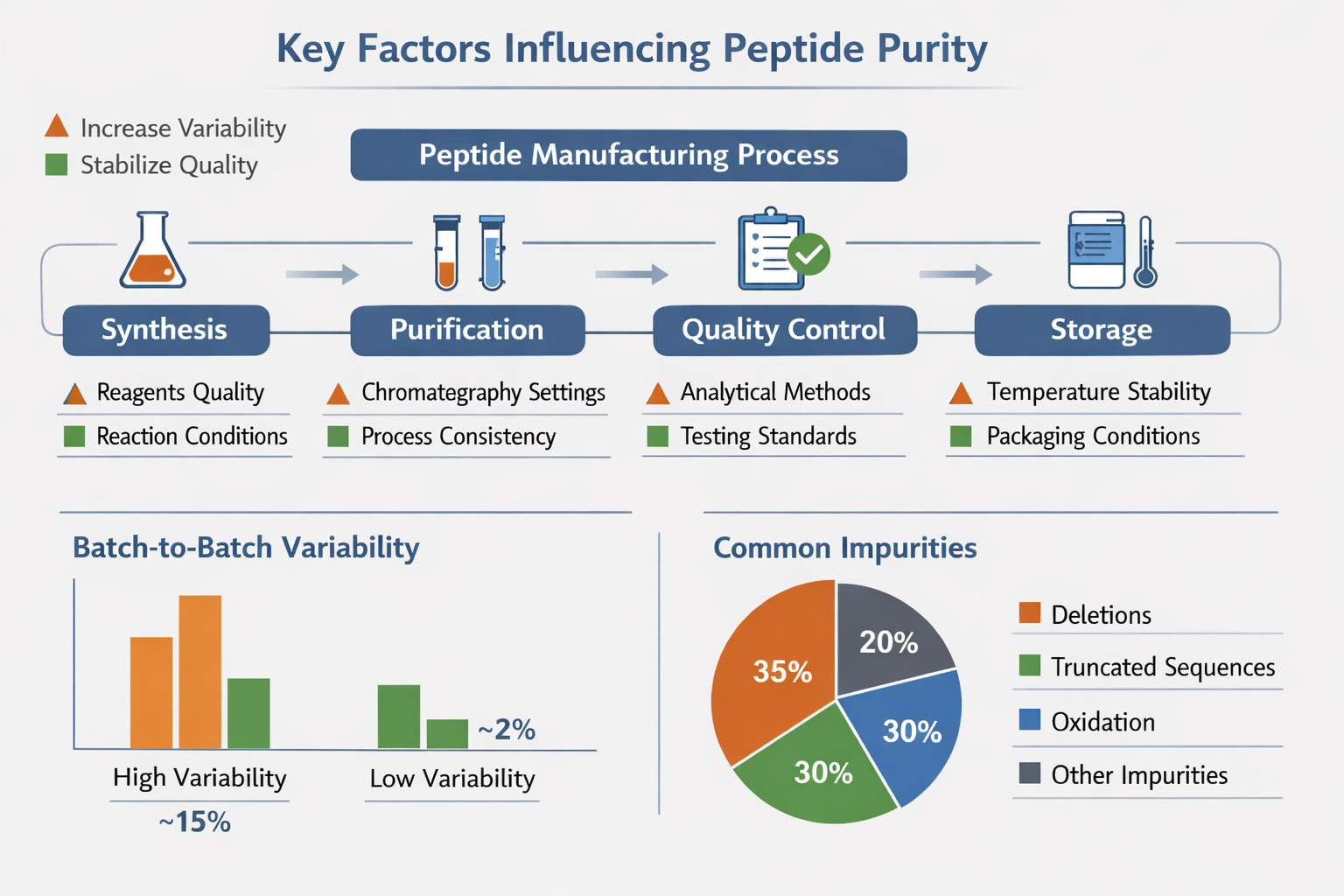
Purity doesn’t happen by accident. It’s the output of a dozen process choices, and any one of them can drag a batch down if it’s not controlled. Resin selection is a good example. The resin is the physical scaffold for SPPS, and different resins vary in loading, swelling behavior, and background contaminants. Cheap resin can shed junk into the process or create uneven reaction access. Better resin usually improves coupling consistency, but it costs more, so this is a common corner to cut.
Coupling efficiency is the next pressure point. Every amino acid addition depends on correct activation chemistry, correct stoichiometry, and enough time to complete the reaction. If coupling is incomplete, you don’t just lose yield, you generate a family of near-miss sequences that complicate purification. Batch size matters here too. Larger batches can suffer from mixing and heat-transfer issues, which means local reaction conditions drift. Smaller batches are easier to control and validate, but they’re more expensive. Automation helps by standardizing timing, temperature, and reagent delivery, though plenty of facilities still run older synthesizers that require more manual judgment (and more opportunities for variation).
Deprotection and cleavage are where things can get ugly fast. You’re removing protecting groups and releasing the peptide from the resin, usually with strong acids. Overdo it and you can degrade sensitive residues. Underdo it and you carry protecting groups into the crude product, which show up as impurities and can alter solubility and impact of peptide purity on bioactivity. Some manufacturers run in-process checks to confirm completion before moving forward. Others lean on end-product testing and hope purification cleans it up. I’ll be blunt, the first approach tends to produce more consistent lots.
Capping is another underappreciated control point. If an amino group fails to couple, capping blocks it from reacting later and creating deletion sequences that masquerade as the real thing. Skip capping, or run it poorly, and you get a cluttered impurity profile that’s hard to separate. Washing between cycles matters too. Inadequate washing leaves residual activators and byproducts behind, which can trigger side reactions in the next step. Solvent quality plays into this more than most COAs admit.
All of these variables interact. Resin quality, mixing, temperature, pH, reagent grade, operator technique, purification method, they don’t fail one at a time. They fail in combinations. That’s why vendors who invest in process validation, tighter environmental controls, and frequent batch testing tend to deliver cleaner chromatograms and better reproducibility. It’s not glamorous work. It’s the work.
Amino Pharm, for example, states a 99% purity standard for US-made peptides and backs that with batch testing. They’re also clear about the intended use, research use only, not human consumption, which matters because this market isn’t regulated like finished pharmaceuticals. Want to connect these manufacturing variables to what you’re seeing in your own data? Start by reading a peptide certificate of analysis a researchers checklist to decode the specs you’re handed.
Quality Control Techniques: Measuring and Interpreting Peptide Purity
Purity measurement isn’t “read the label and move on.” It’s an interpretation problem, and the details matter.
High-Performance Liquid Chromatography (HPLC) is the most common tool. It separates components based on how they interact with the column and mobile phase, then reports peaks. Most suppliers quote purity as the percent area of the main peak relative to the total detected area. That’s useful, but it’s not the same thing as absolute purity by mass. If something doesn’t absorb well at the detection wavelength, or doesn’t elute cleanly, it can be undercounted. Worth noting.
Mass spectrometry (MS) is the usual companion method because it confirms molecular weight and can reveal modifications like oxidation, deamidation, or adduct formation. Some of those changes barely move an HPLC peak, but MS will catch them immediately. Amino acid analysis can add another layer by checking composition and supporting sequence integrity, especially when you’re worried about deletions or substitutions. Together, HPLC plus MS (and sometimes AAA) gives you a more defensible picture of identity and impurity profile.
Certificates of Analysis (COAs) should show the underlying data, not just a headline number. A solid COA typically includes HPLC chromatograms, MS spectra, and method details like column type, gradient, and detection wavelength. Some suppliers also report endotoxin (LAL) results, bioburden, residual solvents, or counterion content (TFA vs acetate), which can matter for cell-based assays. Many COAs don’t include those, and that omission is part of the answer to why peptide purity varies in the real world.
Interpreting COAs means paying attention to what isn’t reported. Two peptides can share the same nominal mass and still behave differently if one contains closely related deletion sequences or subtle chemical damage. Orthogonal methods like capillary electrophoresis or NMR can help resolve edge cases, but outside top-tier manufacturing they’re not common. And even when they’re available, they cost money, so they’re used selectively.
Some vendors, including Amino Pharm, provide more complete analytical documentation with batch testing data, which at least lets you evaluate each lot rather than trusting a marketing claim. Still, the research-peptide market has fewer standardized requirements than regulated pharmaceuticals, so quality control ends up reflecting how much effort and budget a manufacturer is willing to spend on testing and process control.
If you want fewer surprises, you’ve got to get comfortable reading your peptide’s certificate of analysis. It’s not about memorizing jargon. It’s about spotting red flags like extra peaks, missing method parameters, or purity claims without supporting chromatograms. For a practical guide, chec
k out reading a peptide certificate of analysis a researchers checklist to sharpen your evaluation skills.
Purity also affects more than reproducibility. It can change receptor binding, downstream signaling, and apparent pharmacokinetics in muscle growth and recovery models. Cutting corners in QC is a fast way to burn time and publish noise. This is research, not guesswork.
Non-Synthesis Factors Affecting Purity: Storage, Handling, and Degradation
Peptides aren’t invincible. Even if synthesis and purification were perfect, degradation can drag purity down after the fact.
Oxidation is a common culprit, especially with methionine and cysteine residues. A little oxygen exposure can create oxidized species that still look “close enough” on some assays, until they don’t. Hydrolysis is another slow leak, water breaks peptide bonds over time, and humidity speeds it up. Aggregation is its own headache because clumping can change apparent concentration, reduce solubility, and alter bioavailability in cell systems. And yes, it can distort signaling pathway readouts.
Storage conditions matter more than most labs admit. Temperature is the obvious one, room temperature storage accelerates degradation compared with cold or frozen conditions. Moisture is the quiet destroyer. Light can also cause photodegradation, particularly for aromatic residues like tryptophan and tyrosine. That’s why sealed vials, desiccation, and opaque containers aren’t “nice to have,” they’re basic controls.
Handling is where good material often gets ruined. Every vial opening invites moisture and contaminants. Repeated freeze-thaw cycles can accelerate aggregation. Even reconstitution choices matter. Some buffers and solvents increase oxidation risk, and some pH ranges speed deamidation (people forget that part). And if you’re aliquoting on a warm bench because the centrifuge is busy, you’re stacking the deck against yourself (we’ve all seen it).
For research-grade peptides, these aren’t minor issues. Poor storage or sloppy handling can push a peptide below 90% purity, turning a 99% reagent into something you can’t trust. That’s a big deal in growth hormone pathway work or muscle growth models where small integrity changes can shift downstream effects. Amino Pharm includes storage instructions to reduce these risks, but once the shipment arrives, the rest is on the lab. That’s just reality (peptide degradation pathways).
Batch-to-Batch Variability: Why Consistency Is Challenging in Peptide Production
If you expect every vial of a research peptide to be identical, you’re going to be disappointed. Batch-to-batch variability is common, and it starts earlier than most people think.
Raw materials are one source. Amino acid building blocks vary by lot, and small differences in moisture content or trace contaminants can ripple through SPPS. Protecting groups, activators, and solvents can vary too. Even when suppliers provide specs, those specs have tolerances, and tolerances add up.
Process deviations add another layer. Coupling, deprotection, cleavage, purification, lyophilization, each step is sensitive to timing, temperature, and reagent concentration. A small drift, say a couple percent change in coupling efficiency, or a slightly different purification gradient, can shift the impurity profile enough to matter. Operator technique matters as well. Skilled technicians catch problems early. Less experienced staff may not notice a subtle resin aggregation issue until the HPLC looks “busy.”
Some manufacturers use statistical process control (SPC) to track metrics like HPLC purity profiles, yield, and key impurity peaks across lots. Control charts can flag trends before they become failures. Even with SPC, complex or longer peptides tend to show more variability. That’s chemistry.
And the impact is practical. A batch at 92% purity can behave differently than one at 98% in receptor binding, apparent potency, and pharmacokinetics in model systems. A colleague of mine ran into exactly this in recovery assays. Their results kept drifting until they switched suppliers and required lot-specific batch testing for every shipment, no exceptions. The biology “stabilized” overnight, which tells you what the real variable was.
Here’s a quick comparison table summarizing batch variability factors:
|
Factor |
Impact on Peptide Batch Quality |
Example Outcome |
|---|---|---|
|
Raw Material Quality |
Alters final peptide purity and impurity profile |
Increased side-products or truncated peptides |
|
Process Deviations |
Changes in synthesis steps affect coupling and cleavage |
Lower overall yield, unexpected byproducts |
|
Operator Differences |
Variability in technique influences consistency |
Batch-to-batch purity fluctuations |
If you’re trying to answer why do research peptides exhibit variable purity, batch variability is a major piece of it. That’s why suppliers committed to GMP environments and routine batch testing can offer a real advantage. They reduce the odds that your next vial turns your experiment into a guessing game.
How to Critically Interpret Purity Reports and Certificates of Analysis
Reading a certificate of analysis (COA) for peptides isn’t just about spotting a purity percentage and moving on. That headline number, usually 95%, 98%, or 99%, is a summary, not a diagnosis. If you’ve ever wondered why do research peptides exhibit variable purity, the COA is often where the story starts to show.
Start with the testing method. HPLC is the workhorse for peptide purity, but “HPLC-tested” can mean a lot of things. Some suppliers report only the main peak area percentage and call it purity, while leaving out what’s sitting under the smaller peaks. That’s not a technicality, it’s the difference between a clean reagent and a mixed bag. A useful COA includes a chromatogram and an impurity profile that names (or at least characterizes) truncated sequences, deletion peptides, and common synthesis by-products.
Then look at the method details, because vague analytics hide problems. If the COA doesn’t specify the column chemistry (C18 is common, but not universal), mobile phase, gradient, flow rate, and detection wavelength, you can’t compare batches or suppliers in any meaningful way. Peptides can show different peak shapes and retention behavior depending on pH and solvent system, and some impurities co-elute if the method isn’t resolving enough. Worth noting.
Mass spectrometry should be part of the conversation too. HPLC can tell you “how many things” are in the sample, MS helps confirm “what thing” you actually have. A clean MS that matches the expected molecular weight doesn’t prove high purity by itself, but it does reduce the odds you’re working with a modified sequence, an oxidized product, or the wrong peptide entirely. And if you’re running anything sensitive, receptor pharmacology, signaling assays, in vivo PK, it’s a sensible check.
Third-party testing helps when you don’t want to take a supplier’s word for it. Independent labs aren’t perfect, but they’re not grading their own homework. When a supplier can show external verification for identity and purity (HPLC plus MS is typical), the COA reads like documentation, not advertising copy.
I’ve seen how this goes sideways. A client once brought us a “98% pure” growth hormone mimetic peptide that arrived with a one-page COA and no chromatogram. We sent it out for independent testing and found roughly 10% of the material was truncated peptides and synthesis by-products. In their cell assays, the dose-response curve shifted and the signaling readouts got noisy, not because the biology was complicated, but because the reagent was. Big difference.
If you want to interpret purity reports properly, look for these essentials in your COA:
|
What to Look For |
Why It Matters |
|---|---|
|
Purity % by HPLC |
Baseline measure, but not sufficient alone |
|
Impurity Profile |
Identifies contaminants that affect biological activity |
|
Analytical Method Details |
Ensures reliability and repeatability of results |
|
Mass Spectrometry Data |
Confirms correct peptide sequence and modifications |
|
Third-Party Validation |
Adds independent credibility to reported purity |
Remember, “for research use only” doesn’t mean consistent. It just means it’s not approved for human use. This is one of the practical reasons research peptides can show variable purity across vendors and even across lots from the same vendor.
Amino Pharm’s clinically tested, 99% purity peptides stand out because the documentation is actually usable. You’ll see detailed COAs with impurity profiles and external validation, and they’re made in the US under strict quality controls. If you’re studying sensitive mechanisms like muscle growth or recovery signaling pathways, that level of transparency isn’t a luxury, it’s how you keep your data interpretable.
Balancing Purity with Practicality: When Is 'High Purity' Necessary?
You don’t always need ultra-pure peptides. It depends on the question you’re asking, and how much uncertainty your assay can tolerate.
If you’re probing delicate signaling pathways or running pharmacokinetics in vivo, high purity (often 98% to 99%+) is usually the right call. Small impurities can compete at receptors, alter apparent potency, or introduce off-target activity that looks like “biology” until you repeat the experiment with a cleaner lot. And yes, I’m opinionated on this, if your readout is subtle, don’t cheap out on the reagent.
But early-stage work is different. For exploratory in vitro screening, rough structure-activity checks, or assays where the peptide is a minor component in a complex mixture, 85% to 95% purity can be perfectly workable. You’re trading some chemical cleanliness for speed and cost, which is sometimes exactly what a project needs (especially in the first week of a new hypothesis).
The economics are real. Getting from 95% to 99% isn’t a linear jump. It can mean extra prep-HPLC cycles, more solvent, more analyst time, and more yield loss. In practice, that often pushes price per milligram up sharply, sometimes close to doubling depending on sequence difficulty and scale.
Here’s a quick comparison of purity levels and typical use cases:
|
Purity Level |
Typical Applications |
Cost & Time Impact |
|---|---|---|
|
85-90% |
Initial screening, crude in vitro tests |
Lower cost, fast turnaround |
|
90-95% |
Standard research, moderate precision assays |
Moderate cost, balanced speed |
|
98-99%+ |
Pharmacokinetics, in vivo studies, clinical mechanism exploration |
High cost, longer production |
Selecting the right purity comes back to risk control. If you’re studying peptides that mimic growth hormone effects on muscle growth and recovery, impurities can activate off-target pathways or degrade faster than the intended sequence, which can distort PK/PD interpretation. Paying for higher purity can save you money later, because you’re not rerunning weeks of work after a bad lot.
So ask one blunt question before you buy: what’s the cost of being wrong? If you’re teasing out subtle cellular responses, mapping signaling kinetics, or comparing dose-response curves across batches, higher purity is usually the cheaper option in the long run. If you’re just confirming binding affinity in a forgiving assay, moderate purity may be fine.
Amino Pharm’s peptides tend to hit a practical middle ground. Their research-grade products come with transparent peptide purity standards and full batch testing, so you can match the spec to the experiment instead of guessing. And just to be clear, these peptides are for research use only, not human consumption.
If you want a deeper understanding of peptide applications, check out the tb500 peptide mechanism and applications explained for a practical example of choosing purity based on function. For more on how to measure peptide purity and how purity impacts experimental outcomes, the Peptide Purity Guide: Enhance Your Research Outcomes (nextdaypeptides.com) offers solid insights.
Frequently Asked Questions
Why do some research peptides show lower purity despite advanced synthesis methods?
Research peptides can show inconsistent purity because synthesis is a multi-step process: coupling, deprotection, cleavage, and purification. Each step can introduce side reactions or incomplete conversions, especially with difficult sequences that aggregate, contain challenging motifs, or include residues prone to oxidation or rearrangement. Even with modern instrumentation, getting to “effectively pure” is sequence-dependent, and 100% purity isn’t a realistic routine target.
How can I trust a peptide purity report from a supplier?
Trust comes from specifics. Look for batch-specific HPLC chromatograms, stated method parameters, and mass spectrometry results that match the expected molecular weight. If the supplier provides third-party verification, that’s even better. Transparent reporting, consistent lot documentation, and reproducible methods matter more than a single impressive percentage.
Does higher peptide purity always guarantee better experimental results?
No. Higher purity reduces confounders, but it doesn’t fix poor experimental design, unstable peptides, or bad storage practices. The required purity depends on assay sensitivity and the decision you’re trying to make from the data. Some screens tolerate moderate purity, while mechanistic studies, in vivo work, and tight PK comparisons often need higher purity to keep interpretation clean.
What factors during storage can degrade peptide purity after manufacturing?
Moisture, heat, light, and oxygen are the usual suspects. They drive oxidation, hydrolysis, deamidation, and aggregation, which can change both identity and apparent purity over time. Best practice is typically lyophilized storage at low temperature, protected from light and humidity, with minimal freeze-thaw cycles once reconstituted (and using appropriate buffers).
How significant is batch-to-batch variability in peptide research?
It can be significant enough to derail reproducibility. Small differences in synthesis conditions, resin performance, purification efficiency, and QC thresholds can shift impurity profiles between lots. If your project depends on comparability across time, choose suppliers with consistent manufacturing controls, clear batch records, and tight release criteria, then verify critical lots independently when the stakes are high.
References
-
"Peptide Quality – FAQ | AAPPTEC" , peptide.com , https://www.peptide.com/faqs/peptide-quality/
-
"Emerging And Approved Therapeutic Peptides" , globalrph.com , https://globalrph.com/2025/12/emerging-and-approved-therapeutic-peptides-mechanisms-clinical-uses/
-
"Commercial manufacturing of current good …" , sciencedirect.com , https://www.sciencedirect.com/science/article/pii/S2590098620300580
-
"Peptide Purity Guide: Enhance Your Research Outcomes" , nextdaypeptides.com , https://nextdaypeptides.com/enhance-your-outcomes-key-research-peptide-purity-standards/
-
"Guideline on the Development and Manufacture of Synthetic …" , ema.europa.eu , https://www.ema.europa.eu/en/documents/scientific-guideline/guideline-development-manufacture-synthetic-peptides_en.pdf
-
"Q6A guideline" , database.ich.org , https://database.ich.org/sites/default/files/Q6A%20Guideline.pdf
-
"Ensuring Quality by Peptide Purity Testing" , molecularcloud.org , https://www.molecularcloud.org/p/ensuring-quality-by-peptide-purity-testing
-
"Synthetic Peptides: Understanding The New CMC Guidelines" , dlrcgroup.com , https://www.dlrcgroup.com/synthetic-peptides-understanding-the-new-cmc-guidelines/