Quick hook and scope: Why sourcing quality tirzepatide matters
How confident are you that the vial in your freezer contains what the label claims?
Poor material wrecks experiments. A 2025 analysis of online purchases found vials labeled “for research” with inconsistent content and packaging, and some labs reported having to scrap runs after the fact (online purchasing). That shows up fast in the data: shifted dose, response curves, missing mechanism signals, and pharmacokinetics (PK) that look “noisy” because the input material was never consistent.
This guide is for legitimate research-use-only labs running preclinical studies, in vitro work, or assay development. It doesn't cover clinical use or patient administration. Follow institutional approvals and local law, and be aware of legal gray areas when importing or purchasing.
What you’ll get: a procurement workflow, on-receipt QC (quality control) and chain-of-custody steps, storage and prep practices, and compliance guardrails. We’ll also connect the chemistry to practical assay design, how peptide identity, purity, and degradation products can distort signaling readouts.
One caveat up front: no incoming QC panel can prove “clinical equivalence.” It can only show whether a lot meets your stated research specs and behaves consistently in your assays.
Step-by-step procurement workflow for research-use tirzepatide
A team we worked with learned this the hard way. They ran a month of cell signaling assays, then noticed the “new lot” shifted potency by nearly an order of magnitude. The CoA looked fine. LC‑MS later showed unexpected species consistent with degradation, and the entire dataset became hard to interpret.
Step 1, Define experimental specs
Write specs before you shop. Decide your target purity (commonly ≥95% by HPLC), salt form (free base vs acetate; salt form can change solubility), and formulation (lyophilized powder vs liquid). Tie those choices to your assays: receptor signaling, LC‑MS quantitation, stability studies, or PK work.
Set acceptance criteria that you can test: identity by mass spectrometry (MS), purity by HPLC/UPLC, limits for residual solvents, and water content. If your timeline is tight, define a stability window that matches your planned storage and number of thaw cycles.
Step 2, Institutional approvals
Start approvals early. Get IBC sign-off for peptide handling and IRB approval if human samples are involved. Confirm procurement rules, import/export controls, and any local restrictions.
Use an MTA that limits use to research. If your jurisdiction treats certain compounds as controlled, confirm requirements before the PO is issued.
Step 3, Vet vendors
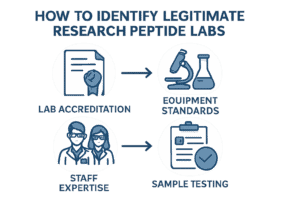
A clean website isn't a quality system. Look for explicit research-use-only labeling, a disclosed manufacturing site, and visible quality controls (ISO/GMP claims are a starting point, not proof).
Ask for lot-to-lot consistency data and batch-testing records. Vendors that publish CoAs by lot are easier to verify and easier to audit.
Step 4, Request documentation and samples
Request a full Certificate of Analysis, plus supporting data: chromatograms, MS spectra, residual solvents, and water content. If the vendor can provide a small verification vial for incoming testing, take it. A $200 sample can prevent a $20,000 study from drifting off course.
Step 5, Purchase terms in the PO
Put your acceptance rules in writing. Include the testing window, rejection criteria, required shipping temperature, packaging requirements, and lead times.
Add return/credit terms if the lot fails independent testing.
Step 6, On-receipt QC and chain-of-custody
Treat every incoming lot as untrusted until it passes your checks.
Log chain-of-custody and storage conditions at receipt. Run an acceptance panel that matches your risk level: HPLC for purity, MS for identity, residual solvent checks, and water content. If you rely on functional readouts, run a small bioactivity assay before scaling.
Table, Vendor claims versus verification
| Vendor claim | What to verify | Acceptable evidence |
|---|---|---|
| ≥95% purity | HPLC chromatogram, retention time | Lot CoA with method, raw chromatogram |
| “Made in USA” | Manufacturing site address | Photos, GMP/ISO certificates |
| Bioactive peptide | Functional assay data | Raw assay data, controls, SOP |
| Stability | Stability study summary | Timepoint data, storage conditions |
Third-party testing and analytical methods
Independent testing is worth it when the experiment is expensive, time-sensitive, or publishable. Use an external lab for orthogonal confirmation (different methods that should agree), such as LC‑MS/MS plus peptide mapping. Strong reports include method validation, limits of detection, and uncertainty.
File those reports with the lot’s chain-of-custody record.
Mechanism and assay considerations
Tirzepatide is a dual agonist at GLP‑1 and GIP receptors. Those pathways can shift downstream markers that many labs track, including cAMP signaling and metabolic readouts; in some animal models, secondary endocrine effects can also move growth hormone, related markers. Controls matter.
Separate PK effects from on-target signaling. If you're modeling muscle outcomes, include PK sampling and a time course so you don’t confuse short-lived signaling spikes with sustained changes. The StatPearls review is a useful clinical pharmacology primer.
Vendor examples and naming traps
Search phrases like “research peptides for sale tirzepatide” or “buy tirzepatide for research” don’t tell you anything about identity or purity. Verify the CoA, request raw data, and insist on lot-specific testing.
Our team supplies research-grade, US-made peptides that are clinically tested and 99% purity, but the same rule applies: label and handle all material as not for human use, only for research use.
Final checklist before use
- CoA present and matches your acceptance criteria.
- Chain-of-custody logged from vendor to freezer.
- Independent sample tested or third-party report on file.
- Storage plan (temperature, light protection) and inventory tracking.
- MTAs and approvals complete.
Quarantine new lots until they pass. It saves weeks.
Key Takeaways
- Don’t order until you define experimental specs: ≥95% HPLC purity, salt form, formulation, and stability needs.
- Get IBC/IRB signoff, MTAs, and import/export clearance before procurement.
- Quarantine shipments until LC‑MS, peptide mapping, HPLC purity, endotoxin, and residual solvent checks pass.
- Record vendor, PO, lot, receipt temperature, receiver signature, scanned CoA, and storage location in LIMS.
- For critical experiments, prioritize third‑party tested Tirzepatide for Research lots over vendor CoA only.
Essential on‑receipt QC tests and acceptance criteria
If you only run one test, make it identity.
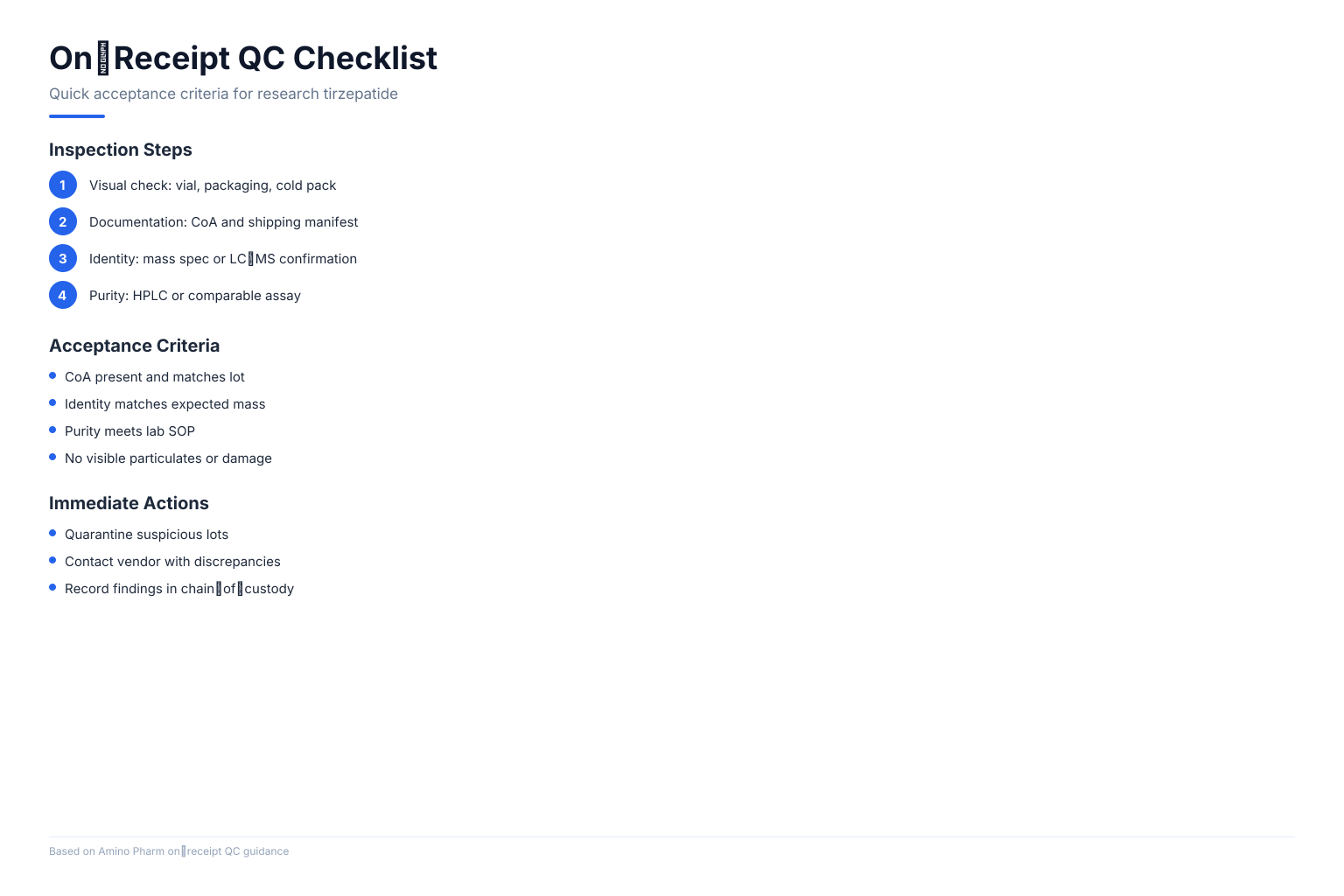
Start with LC‑MS tirzepatide to confirm intact mass and the expected mass shift from lipidation (the fatty chain added to extend half-life). Then run peptide mapping (enzymatic digestion plus MS) to confirm sequence coverage and detect truncated species or unexpected modifications.
Next, check purity and related substances. Use HPLC or UPLC to generate an area‑percent profile. A practical research threshold is often ≥95% main peak, but set yours based on assay sensitivity. Identify major impurities by LC‑MS rather than assuming they're harmless.
If sequence confirmation is unclear, add an orthogonal check such as amino acid analysis or N‑terminal sequencing.
| Test | Method | Suggested acceptance |
|---|---|---|
| Identity | LC‑MS tirzepatide, peptide mapping | Mass match. Lipidation mass shift confirmed |
| Purity | HPLC/UPLC area% | ≥95% main peak |
| Residual solvents | Headspace GC | ICH Q3C limits per solvent |
| Water content | Karl Fischer | <5% typical for lyophilized peptides |
| Endotoxin | LAL or recombinant Factor C | ≤0.1 EU/mL for sensitive cell assays |
| Sterility (cell culture use) | USP <71> or validated method | Sterile. No growth |
| Potency | In vitro bioassay (cAMP, receptor binding) | Match reference activity |
Residual solvents and water can change stability and apparent potency. Measure solvents by headspace GC and water by Karl Fischer. Excess water can drive hydrolysis and speed degradation. Residual solvents can change solubility and interfere with sensitive assays.
Endotoxin testing matters for cell work. Use LAL or recombinant Factor C assays. For primary cells, ≤0.1 EU/mL is a common target, and some immune assays need stricter limits. If the material is for non‑cell assays, record the endotoxin value and decide based on risk.
Potency checks are optional, but they catch a common failure mode: a lot that looks “clean” by HPLC yet underperforms in biology. Use receptor binding or a downstream cAMP assay and compare against a reference standard.
Batch documentation must travel with the vial: vendor, lot number, CoA, manufacturing date, storage conditions, expiry, and your QC checklist (including LC‑MS tirzepatide and HPLC results). Cross‑check the CoA against your internal peptide quality checks. We source peptides from Amino Pharm, which provides clinically tested, 99% purity, US made peptides, and we always mark material "not for human use, only for research use." Keep raw data with the batch record so an auditor, or your future self, can trace decisions.
Documenting chain-of-custody and traceability best practices
Reproducibility isn't just methods. It’s materials.
Chain-of-custody supports troubleshooting, audits, and publication review. When a reviewer asks how you handled a reagent, clean records prevent guesswork and shorten root-cause analysis.
Minimum receipt records: vendor, PO number, lot number, shipment tracking, temperature at receipt, receiver signature, date/time, attached CoA, and storage location. Quarantine until QC sign‑off. Photograph packaging and vial labels at opening and store images with the lot record.
Use a secure LIMS to link scanned CoAs and raw data to the sample entry. Barcode labels reduce transcription errors. Attach the versioned SOPs used for acceptance testing so you can show exactly what was done.
A simple workflow works well: quarantine → run QC tests → sign off in LIMS → release to inventory. If rejected, photograph the issue, attach test results, and notify the vendor using a standard template.
Retention: keep raw QC data, CoAs, and chain-of-custody records for at least seven years for most research programs. If you expect external review or IP filings, consider sto

ring an archive vial at −80°C and logging its location.
For examples of strict lot tracking, see clinical trial documentation such as the clinical trial data. Label everything clearly as research material. Tirzepatide for research isn’t for human use, only for research use.
Storage, handling and preparation: maintaining integrity from freezer to assay
Cold storage isn't optional. It’s part of the method.
Store lyophilized powder at −20°C to −80°C for long-term stability. Use 2, 8°C only for short windows and only in a monitored refrigerator. Once water is present, many peptides degrade faster.
Shipments should use validated dry ice or frozen shippers with temperature indicators and documented chain-of-custody. Record temperature excursions. If the cold chain breaks, quarantine and re-test before use. For broader sourcing context, see the FDA guidelines on unapproved GLP-1 products.
Avoid repeat freeze, thaw cycles. Thaw on ice or at 2, 8°C, mix gently, and aliquot into single-use low-binding vials. Label each aliquot with concentration, solvent, open date, and lot.
Reconstitution depends on your assay. Sterile water works for many setups. If solubility is poor, use a small amount of DMSO and keep final DMSO in the assay under 0.5%. Make a concentrated stock, then dilute stepwise into assay buffer to reduce precipitation.
For cell culture, use sterile technique and filter through a 0.2 µm filter after reconstitution. Use sterile consumables. Request an endotoxin certificate and test in-house when your assay is sensitive.
Tirzepatide is lipidated for albumin binding. That helps half-life but can reduce aqueous solubility and increase surface adsorption (sticking to plastic). Use low-binding polypropylene or glass. If compatible with your assay, consider 0.01% Tween‑20 or 0.1% BSA to reduce loss to surfaces, and validate first, detergents and proteins can change signaling readouts.
Monitor stability with periodic HPLC or potency checks, often every six months for long-term stocks. Maintain freezer alarms and a backup plan.
We can provide CoAs and stability data on request. All research peptides are labeled for research use only, not for human use.
Vendor selection checklist and quick comparison approach
If you had to defend your supplier choice in a lab meeting, what would you show?
Compare vendors using objective criteria: RUO labeling, full CoA access, third-party testing options, manufacturing transparency, lot consistency, lead time, and return policy. Ask for endotoxin and stability reports before you buy.
Use this 10-point rubric (0/1 each) for a quick pass/fail.
| Category | Weight |
|---|---|
| Documentation (CoA, MS) | 2 |
| QC stringency | 2 |
| Cold-chain capability | 1 |
| Communication | 1 |
| Pricing | 1 |
| Sample policy | 1 |
| Legal compliance | 1 |
| Lead time | 1 |
| Customer references | 1 |
| Third-party testing | 2 |
If a vendor scores below your threshold for critical work, require third-party tested lots. For routine screening, a vendor CoA may be enough if you spot-check and the supplier shows consistent batch history.
Sample request template: "Please provide full CoA, MS chromatograms, residual solvent report, endotoxin certificate, and any real-time stability data for this lot. Acceptance contingent on matching purity and endotoxin specs. Unopened returns accepted within X days."
Watch for red flags: human-use labeling sold as “research,” unknown API origin, or refusal to share lot-specific documentation. Public reporting has highlighted counterfeit and substandard GLP‑1 products in online channels (online purchasing). The StatPearls review also explains why small changes in material quality can change biological outcomes.
Requalify suppliers annually or when you see drift. For high-stakes studies, order two independent lots and compare them before committing.
Red flags, common problems and troubleshooting protocols
Assume problems will happen. Plan for them.
On receipt, red flags include missing or inconsistent CoA data, prices far below market, discoloration, moisture in vials, or labels without lot numbers and expiry. For tirzepatide, missing storage temperature guidance or unclear manufacturer ID should trigger quarantine.
Analytical warning signs: unexpected masses on LC‑MS, broad or split HPLC peaks (often degradation or aggregation), high endotoxin, or sterility failures. Any one of these can invalidate sensitive assays.
Operational response: quarantine the lot, photograph packaging and labels, log chain-of-custody, and escalate with evidence. Arrange expedited third‑party testing before reuse.
Return the product if it fails acceptance criteria, if chain-of-custody is broken, or if documentation gaps remain after escalation. Follow your internal troubleshooting SOPs and involve QA.
Ready to optimize your peptide use?
Treat procurement like part of your experimental design.
| Step | Action |
|---|---|
| Receipt | Verify CoA, lot, expiry, temp |
| Reconstitution | Use validated buffer, aliquot |
| Storage | −20°C short term, −80°C long term |
| QC | HPLC, LC‑MS, endotoxin, sterility |
| Documentation | Chain‑of‑custody, batch testing log |