Why Understanding Peptide Influence on Cellular Signaling Is Crucial for Research
Peptides aren’t just tiny chains of amino acids anymore. They’re central players in cellular communication. Recent datasets and pathway annotations suggest that a majority of mammalian signaling routes touch peptides somewhere in the chain, either as ligands, cofactors, or modulators. A number you’ll see cited is “over 60%,” and while that depends on how you define “involve,” the direction is right: peptide-mediated signaling is everywhere. Worth noting.
A 2023 cell-culture study, for instance, used synthetic peptides to modulate the growth hormone axis and then tracked downstream readouts tied to muscle growth and recovery. The interesting part wasn’t the headline effect, it was the clean mechanistic linkage between receptor engagement and measurable pathway outputs. That kind of work is why peptide signaling keeps showing up in muscle wasting disease models and in basic receptor pharmacology papers.
Peptide research has grown fast because these molecules can be unusually precise. Compared with many small molecules, peptides often bind with high receptor selectivity, and they can be engineered in straightforward ways to test a hypothesis. In practice, labs use research-grade peptides to map signaling networks, stress responses, and receptor dynamics, then connect that biology to pharmacokinetics, disease mechanisms, and target validation. Big difference.
Interest has also climbed because QC has improved. If you’re studying how peptides influence cellular signaling pathways in research, purity and identity aren’t “nice to have,” they’re the experiment. I’ve watched a collaborator spend two weeks chasing a phantom phenotype that disappeared the moment we swapped in a verified lot with a clean certificate of analysis. Painful lesson, but common. Suppliers like Amino Pharm emphasize clinically tested, US-made peptides with over 99% purity, and that standard matters because inconsistent material can wreck receptor occupancy assumptions, shift dose response curves, and create irreproducible phosphorylation data. This article breaks down the molecular mechanisms behind peptide action and how that knowledge should shape experimental design, so you can separate biology from batch noise and trust what you’re seeing.
Fundamentals of Peptide Interaction with Cellular Signaling Pathways
What are peptides in cellular signaling terms? Short amino acid chains, typically 2 to 50 residues, that act as messengers or modulators within and between cells. Unlike full proteins, peptides are small enough to diffuse, bind, and clear quickly, which is exactly why they’re useful in mechanistic studies. In research settings, they show up as endogenous ligands, synthetic agonists or antagonists, and as “probe” sequences designed to map pathway topology.
Most biochemical peptide interactions boil down to two variables: affinity and specificity. A peptide’s conformation, charge distribution, and hydrophobic patches shape how tightly it binds a receptor and which downstream cascade it favors. Peptides that target G protein-coupled receptors (GPCRs) often resemble endogenous ligands closely, and the fit can be surprisingly unforgiving. Swap one residue, change a terminal group, or alter stereochemistry, and you can flip a receptor from active to inactive, or bias signaling toward one branch of the pathway while damping another. That flexibility is why peptides are such strong tools in receptor pharmacology, and why rigorous analytical verification is non-negotiable if you want comparable results across experiments.
Peptide-modulated signaling pathways usually fall into a few well-characterized buckets:
|
Pathway Type |
Description |
Examples of Peptide Modulators |
|---|---|---|
|
GPCR (G-protein coupled receptors) |
Largest family of receptors, mediating responses to hormones, neurotransmitters, and sensory stimuli |
Growth hormone-releasing peptides, opioid peptides |
|
RTK (Receptor tyrosine kinases) |
Receptors that phosphorylate tyrosine residues to trigger signaling cascades |
Epidermal growth factor (EGF), insulin-like peptides |
|
Ion Channels |
Peptides can gate or modulate ion channels, affecting membrane potential and signaling |
Toxins or synthetic peptides that modulate calcium or potassium channels |
Muscle biology offers a clear example. Growth hormone secretagogues, small peptides, bind GPCRs and stimulate endogenous growth hormone release, which then propagates through downstream signaling tied to muscle growth and recovery. With well-characterized research peptides, labs can actually connect dose to receptor occupancy and then to pathway readouts, such as phosphorylation patterns or transcriptional changes, rather than guessing based on phenotype alone.
And the receptor pharmacology vocabulary matters here. Agonists activate receptors, antagonists block activation, and biased ligands preferentially trigger some signaling outputs while minimizing others. Biased signaling can complicate interpretation, but it’s also one of the best ways to dissect pathway causality without knocking out half the cell’s machinery.
If you want a concrete illustration of how small structural differences translate into distinct cellular outcomes, mechanisms of GLP-3 peptide is a useful reference point. It’s a good reminder that “peptide” isn’t a single category, sequence and chemistry drive the biology.
Ultimately, peptides shape cellular signaling by acting as molecular switches and tuners, not just on-off triggers. The peptide-receptor interaction is messy in the real world, cell type, receptor density, and media conditions all matter, but getting the fundamentals right is what turns signaling experiments from interpretive art into reproducible science.
Key Receptors Engaged by Research Peptides and Their Signaling Cascades
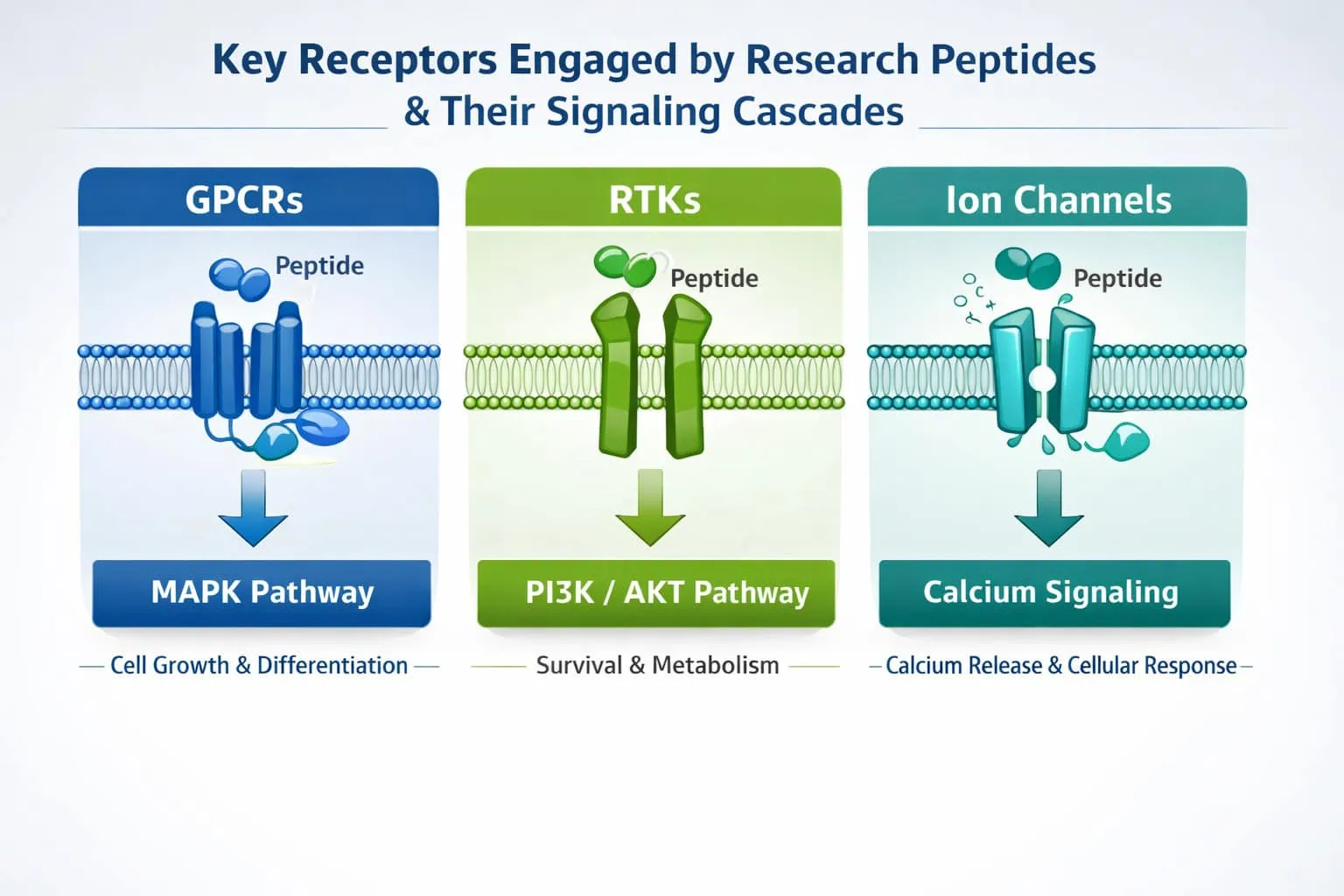
Peptides don’t drift around randomly. They bind receptors, and those receptors dictate what happens next. GPCRs and receptor tyrosine kinases (RTKs) are the usual headliners, but ion channels and integrins also show up often enough to deserve attention. If you’re working on growth hormone biology, muscle growth, or recovery models, you’re almost certainly dealing with one or more of these receptor classes.
GPCRs are the best-mapped peptide receptor family for a reason. They’re seven-transmembrane proteins that translate extracellular binding into intracellular signaling through heterotrimeric G proteins. Once a peptide binds, the receptor changes shape and activates a G protein, which then shifts second messengers such as cyclic AMP (cAMP), inositol trisphosphate (IP3), or diacylglycerol (DAG). Those second messengers propagate the signal, often through kinase cascades that affect metabolism, cytoskeletal dynamics, and gene transcription. Many peptide hormones tied to muscle phenotypes, including growth hormone-releasing peptides (GHRPs), signal primarily through GPCRs.
RTKs behave differently. They’re single-pass membrane receptors with intrinsic kinase activity, meaning they phosphorylate tyrosine residues after activation. Peptide binding often promotes receptor dimerization, followed by autophosphorylation, which creates docking sites for adaptor proteins and enzymes. That recruitment drives pathways like MAPK/ERK and PI3K/Akt, both central to proliferation, differentiation, and survival. Insulin-like growth factor (IGF) peptides are classic RTK-linked examples in muscle recovery and growth research.
A quick rundown of the usual sequence of events:
|
Receptor Type |
Peptide Interaction |
Activation Mechanism |
Downstream Effects |
|---|---|---|---|
|
GPCR |
Peptide binds extracellular domain |
Conformational change → G protein activation |
Second messenger production (cAMP, IP3), phosphorylation cascades, gene regulation |
|
RTK |
Peptide induces receptor dimerization |
Autophosphorylation on tyrosine residues |
Activation of MAPK/ERK, PI3K/Akt pathways |
|
Ion Channel Receptors |
Peptides act as ligands or modulators |
Channel opening or modulation |
Changes in intracellular Ca2+ levels, membrane potential shifts |
|
Integrins |
Peptides bind extracellular matrix domains |
Trigger intracellular signaling complexes |
Cytoskeletal rearrangements, survival signals |
Ion channels and integrins don’t get the same airtime, but they matter. Some peptides modulate ion channels directly, shifting calcium influx and downstream calcium-dependent signaling, which is highly relevant in muscle contraction and recovery studies. Integrins connect the extracellular matrix to the cytoskeleton, and peptides that bind integrins can change adhesion, migration, and remodeling, all key in tissue repair models (and yes, they can confound your interpretation if you’re not watching for it).
Amino Pharm supplies peptides aimed at these receptor classes with research-grade purity, and that’s not marketing fluff. Consistent material helps you interpret pathway effects without wondering if lot variability changed receptor engagement or altered pharmacokinetics in your system. If you’re trying to answer how do peptides influence cellular signaling pathways in research, controlling that variable is table stakes.
One practical example is TB500. It’s often discussed in the context of tissue repair, and its effects connect back to cytoskeletal regulation, including actin dynamics, through receptor-mediated signaling and downstream network effects rather than a single tidy target. The TB500 peptide mechanism is a helpful overview for researchers trying to connect receptor engagement to observable cell behavior.
These receptor systems also cross-talk. GPCR and RTK pathways can intersect through shared kinases, scaffold proteins, and feedback loops, which is why clean mapping typically requires binding assays, second-messenger measurements, and phosphorylation tracking, not just one endpoint readout. I’ll say it plainly: relying on a single phospho-marker and calling it “mechanism” is a bad habit in peptide signaling work.
Molecular Mechanisms Underlying Peptide-Induced Signal Transduction
Peptide-triggered signaling starts with ligand-receptor binding. After that, the details get complicated fast. Binding induces allosteric shifts, the receptor changes shape in ways that increase or decrease activity, recruit partners, or alter trafficking. That conformational change is the spark.
In GPCR-mediated signaling, peptide binding stabilizes an active receptor state that promotes GDP-to-GTP exchange on the Gα subunit. Gα and Gβγ then regulate effectors such as adenylate cyclase or phospholipase C, generating second messengers that amplify the signal. One binding event can ripple outward into broad phosphorylation changes and, eventually, altered gene expression. But the amplification cuts both ways, small experimental artifacts can balloon into “results” if controls are weak.
RTKs often feed into MAPK/ERK. A peptide activates the receptor, autophosphorylation follows, and adaptor proteins like Grb2 and SOS recruit and activate Ras. Ras triggers the Raf, MEK, ERK kinase cascade, and ERK influences transcription factors that regulate division and differentiation. This pathway is frequently implicated in muscle growth and repair phenotypes, and it’s a common readout in recovery-focused studies.
PI3K/Akt is another major axis. PI3K generates phosphorylated membrane lipids that recruit Akt, which then activates growth and survival programs through targets such as mTOR. Growth hormone-related peptides often connect to this signaling route in muscle models. But there’s a caveat people sometimes gloss over: sustained Akt activation can look a lot like oncogenic signaling in the wrong context, so dose, exposure time, and cell line choice matter more than many protocols admit.
Calcium signaling belongs in this conversation too. Some peptides increase intracellular Ca2+ via IP3-mediated release from the endoplasmic reticulum, or by modulating calcium channels. Calcium is a fast second messenger with broad reach, it can change enzyme activity, transcription, and contractile behavior in muscle-relevant systems.
A case study makes the point. Research on ABP-7 peptide reported receptor binding that activated both MAPK/ERK and Ca2+ pathways, shifting proliferation and differentiation in cultured fibroblasts (fwweekly.com). Dual-pathway activation like this is common, and it’s exactly why “one peptide, one pathway” is usually an oversimplification.
|
Pathway |
Key Players |
Outcome |
Typical Peptide Examples |
|---|---|---|---|
|
MAPK/ERK |
RTK → Grb2/SOS → Ras → Raf → MEK → ERK |
Cell proliferation, differentiation |
IGF peptides, epidermal growth factor |
|
PI3K/Akt |
PI3K → PIP3 → Akt → mTOR |
Cell growth, survival, metabolism |
Growth hormone analogs |
|
Ca2+ Signaling |
IP3 → Ca2+ release, channel modulation |
Enzyme activation, gene expression, contraction |
Calcitonin gene-related peptide, TB500 |
|
cAMP Pathway |
GPCR → Gs → adenylyl cyclase → cAMP |
Metabolic regulation, gene transcription |
GHRPs, glucagon-like peptides |
That table captures the big routes, but real systems don’t always follow the diagram. Pathway selection depends on receptor type, ligand affinity, receptor density, cell state, and peptide modifications. And batch variability can be brutal. We’ve seen “identical” peptides from poorly controlled sources produce different phosphorylation kinetics, likely due to impurities, truncations, or oxidation (metionine is a repeat offender, by the way). If you don’t verify identity and purity, you can end up publishing a story about your supplier’s QC instead of your biology.
If you’re analyzing how peptides influence cellular signaling pathways in research, these molecular details aren’t academic trivia. They’re the difference between interpretable data and noise. Using peptides from a reliable supplier like Amino Pharm, with US-made, 99% purity products, helps ensure your readouts reflect biology rather than contaminants or inconsistent pharmacokinetics. These compounds are strictly for research use, not human consumption.
And yes, advanced analytical methods help. Mass spectrometry can confirm identity and detect truncations or modifications, while phosphoproteomics can reveal pathway bias you’d miss with a couple of western blots. The more closely you look, the more you realize pepti

de signaling is powerful, precise, and occasionally unpredictable (which is part of the appeal).
For broader biochemical context, The ins and outs of peptide signaling (sciencedirect.com) is still a solid foundational read on peptide communication across organisms.
Experimental Considerations: Designing Research Using Peptides to Modulate Signaling
Choosing the right peptide isn’t about picking a sequence that sounds plausible. You’ve got to think about specificity, stability, receptor engagement, and the chemical details that determine whether the peptide survives long enough to do anything. Research-grade peptides should ship with a certificate of analysis confirming identity and purity, and I don’t run signaling experiments without reviewing it first. When ordering from suppliers like Amino Pharm, which offers US-made, clinically tested peptides with over 99% purity, that documentation should be part of the workflow, not an afterthought.
Sequence drives receptor specificity. Closely related peptides can bind different receptor subtypes, or trigger distinct downstream programs through the same receptor, depending on small amino acid changes. In growth hormone-related work, for example, fragment-like peptides can vary widely in receptor affinity and in which signaling readouts they move, even when the sequences look “basically the same” on paper. Stability is just as important. Peptides degrade quickly in protease-rich media, and that degradation can create active fragments that muddy interpretation. Chemical modifications like N-terminal acetylation or C-terminal amidation can extend half-life, but they can also shift binding, bias signaling, or change apparent pharmacokinetics. It’s always a trade-off.
Delivery is where many peptide studies quietly fail. Adding peptide directly to culture media is simple, but many sequences won’t cross membranes efficiently. That’s when cell-penetrating peptides, liposomal encapsulation, or electroporation become options. Each comes with costs. Electroporation can deliver intracellularly with high efficiency, but it can also stress cells and distort signaling readouts if parameters aren’t tuned. Liposomes can protect peptides from degradation, yet they may introduce dosing variability and uptake heterogeneity. There’s no universal “best,” only what’s best for your cell type and endpoint.
Dosing needs discipline. Micromolar concentrations are common in vitro, but effective doses can vary by orders of magnitude based on receptor density and affinity. Exposure time matters too. Some pathways respond in minutes, others need hours before you see transcriptional effects. Run dose-response and time-course experiments early, even if it feels slow. It saves weeks later.
Controls are the difference between a mechanistic claim and a guess. Scrambled peptides, vehicle-only controls, and where possible, receptor blockade or knockdown, help confirm specificity. Off-target binding is a real issue, especially for peptides with homology to endogenous ligands or those that interact with multiple receptor families. Mechanistic readouts should match the hypothesis, western blots for pathway nodes, reporter assays for transcriptional outputs, binding assays for receptor engagement, and ideally orthogonal confirmation.
Interpretation takes restraint. Peptides can trigger receptor internalization, desensitization, or biased signaling where one branch lights up and another stays quiet. A phosphorylation increase doesn’t automatically mean the expected phenotype will follow. Batch testing helps keep your baseline stable, because lot-to-lot differences in purity, truncation profiles, or oxidation can create experimental drift and waste time.
Peptide experimental design is detail-heavy. The wrong sequence, delivery method, or control set can derail months of work. But when the design is tight, peptides are one of the cleanest ways to probe signaling with temporal control and receptor-level specificity that’s hard to match.
Comparative Analysis: Peptides Versus Other Signaling Modulators in Research
Why pick peptides instead of small molecules, antibodies, or genetic tools for signaling studies? Because each tool class trades off specificity, reversibility, and practicality in different ways.
Small molecules are popular because they’re stable, often cell-permeable, and usually come with well-described pharmacokinetics. The catch is specificity. Plenty of small molecules hit multiple targets, and that promiscuity can blur mechanism, especially in kinase-heavy pathways. Peptides often provide tighter receptor selectivity because their sequence-defined surfaces can mimic endogenous ligands closely. That makes them particularly useful for teasing apart receptor subtype behavior and biased agonism.
Antibodies can be extremely specific too, but their size limits cell penetration. In most signaling experiments they’re better as detection reagents or extracellular blockers than as intracellular modulators. They also tend to bind with slow off-rates, which makes temporal control harder. Peptides, by contrast, are usually reversible. Washout experiments are straightforward, and that’s valuable when you’re studying dynamic signaling, feedback loops, and desensitization.
Genetic approaches like siRNA and CRISPR change signaling at the expression level. They’re excellent for long-term perturbations, but they don’t offer the same timing control, and off-target effects and delivery challenges are still routine. Peptides act at the protein level, so you can see effects quickly without waiting for transcriptional and translational shifts.
Here’s a quick rundown:
|
Modulator Type |
Specificity |
Reversibility |
Ease of Use in Cells |
Typical Applications |
|---|---|---|---|---|
|
Peptides |
High (sequence-based) |
High (washout) |
Moderate (delivery challenges) |
Probing receptor-ligand interactions, biased signaling studies |
|
Small Molecules |
Variable (often low) |
Moderate |
High (membrane permeable) |
Broad pathway modulation, drug screening |
|
Antibodies |
Very high |
Low (irreversible) |
Low (extracellular only) |
Target validation, receptor blocking |
|
Nucleic Acids |
High (gene-level) |
Low (long-term) |
Moderate (transfection needed) |
Gene knockdown/knockout, long-term pathway modulation |
Peptides often sit in the middle ground researchers want: high specificity with reversible control. In muscle-focused work, peptides that mimic growth hormone fragments can selectively activate signaling tied to growth and recovery, offering insights that broader small-molecule agonists can miss. A study reported that modified peptides could bias receptor signaling toward anabolic pathways over catabolic ones, a nuance that was harder to replicate with small molecules (research from nature.com).
But peptides aren’t magic. Delivery and stability can be annoying, and anyone who says otherwise probably hasn’t optimized a peptide protocol across three cell lines and two serum conditions. If you need transient receptor engagement or subtype-specific signaling, peptides are often the right call. If you need durable gene-level suppression or broad pathway inhibition, other tools may fit better.
Most good signaling programs mix methods. Peptides for precision perturbation, small molecules for complementary inhibition, genetics for causality. That combination usually produces the cleanest mechanistic story.
For peptide experiments, source from reputable suppliers like Amino Pharm with rigorous batch testing, and check the peptide certificate of analysis before you run anything expensive. If you’re curious about peptide roles beyond human systems, Secret Molecular Messengers with a Mighty Role in Plant Life (link.springer.com) is a strong reminder that peptide signaling is evolutionarily conserved in ways that can sharpen your intuition. Just remember, peptides are for research use only, not for human consumption.
Emerging Trends: Synthetic and Engineered Peptides in Advanced Signaling Studies
Synthetic peptides have come a long way from “handy reagents.” Engineered peptides are now precision tools built to probe, perturb, or, yes, intentionally reroute cellular signaling pathways. The aim is straightforward: higher target specificity, better stability in biological matrices, and, in many cases, improved membrane permeability where native peptides often fall short.
Take stapled peptides. These are chemically constrained to maintain a defined 3D conformation, commonly an alpha-helix. That conformational “lock” increases resistance to proteolysis and often improves binding affinity to the intended protein interface. Think of it like a key that keeps its shape under heat and humidity, it still fits after a long day on the bench. Worth noting. Signaling biology depends on short-lived, highly specific protein–protein interactions, so anything that stabilizes a probe without changing its pharmacology can materially improve interpretability. A 2022 review highlighted how stapled peptides can inhibit oncogenic signaling by engaging intracellular targets that were long treated as “undruggable” in practice, see the nature.com discussion here: https://www.nature.com/articles/s41392-022-00904-4.
Cell-penetrating peptides (CPPs) add a different capability: delivery. CPPs can transport cargo across the plasma membrane, including peptides, proteins, and nucleic acids. In signaling studies, that means you can modulate intracellular nodes directly instead of being limited to extracellular ligands and surface receptors. And that matters when the biology you care about lives on the cytosolic face of a receptor, or downstream at a scaffolded kinase complex. We’ve seen labs use CPP-tagged modulators to interrogate growth-related pathways in muscle models by targeting intracellular receptor domains and proximal signaling adapters, then reading out phosphorylation changes by immunoblot or targeted LC-MS. Preclinical, yes. Still informative.
Peptide mimetics deserve attention for a more practical reason: they often behave better in experiments. Rather than using a peptide sequence as-is, mimetics reproduce the functional pharmacophore with a synthetic scaffold that can be more stable, easier to derivatize, and sometimes less expensive at scale. That flexibility lets researchers tune affinity, selectivity, and half-life while keeping the same signaling hypothesis. One recent line of work used mimetics to parse cross-talk between inflammatory signaling and cellular metabolism, the key point was that the native peptide degraded too quickly to support longer time-course readouts, so the mimetic made the experiment possible. Big difference.
All of these tools come with a less glamorous requirement: analytical discipline. Small differences in purity, counterion composition, oxidation state (Met oxidation is a repeat offender), or aggregation can move a signaling readout enough to send you chasing the wrong mechanism. If you’ve ever watched a “clean” dose response fall apart after a new lot arrives, you know what I mean (and it’s maddening). That’s why sourcing research-grade material with transparent QC, batch-to-batch documentation, and validated purity isn’t optional. Amino Pharm states 99% purity and US-made production for its research peptides, and for signaling work, that kind of specification is the baseline you want, not a nice-to-have.
Here’s a snapshot of how these engineered peptides stack up in signaling pathway research:
|
Peptide Type |
Key Advantage |
Application Example |
Stability Profile |
|---|---|---|---|
|
Stapled Peptides |
Structural rigidity, target affinity |
Blocking oncogenic protein-protein interactions |
High, resistant to proteases |
|
Cell-Penetrating Peptides |
Intracellular delivery |
Modulating growth hormone receptor signaling |
Moderate, enhanced intracellular stability |
|
Peptide Mimetics |
Chemical versatility, cost-effective |
Dissecting inflammatory and metabolic crosstalk |
High, improved pharmacokinetics |
A lot of advanced signaling papers now pair engineered peptides with phosphoproteomics to map pathway flow, not just endpoint effects. One high-impact approach in muscle cells, for example, used engineered probes to resolve discrete phosphorylation events downstream of growth hormone stimulation, separating early receptor-proximal events from later transcription-linked changes. That’s the sort of mechanistic clarity you need if you’re trying to connect a receptor event to hypertrophy markers, mitochondrial biogenesis, or insulin sensitivity. I’ll be blunt: “it changed pERK” isn’t a mechanism.
If you’re planning to work with engineered peptides, start by matching the chemistry to the biological question. Need intracellular access? Consider CPPs, but plan controls for uptake and endosomal trapping. Need to disrupt a helix-mediated interface? Stapling may help, but confirm you haven’t altered receptor bias or created a sticky, non-specific binder. And don’t forget the boring part: peptide quality can matter as much as assay sensitivity.
Integrating Peptide Signaling Insights into Broader Experimental Frameworks
Turning peptide signaling data into something you can act on is where good projects separate from pretty figures. Peptide experiments rarely stand alone. They should feed into drug discovery, disease modeling, and systems biology workflows, otherwise you’re left with a mechanistic anecdote that doesn’t travel.
Peptides often modulate pathways that are already therapeutic targets, GPCRs, RTKs, cytokine receptors, and their downstream kinases. When you understand the pathway architecture in detail, you can spot new intervention points or refine existing ones. Growth hormone axis work is a clear example in muscle growth and recovery studies, with obvious implications for muscle atrophy and metabolic disorders. But a pathway “shift” isn’t the endpoint. You still have to connect receptor engagement to phenotype, then to something that resembles a translational endpoint, even if it’s only a validated biomarker panel in vitro.
Omics helps, when it’s used carefully. Transcriptomics, proteomics, and especially phosphoproteomics can show how a peptide perturbation propagates across networks, including feedback loops and compensatory signaling. Overlaying those datasets with time-resolved signaling readouts (minutes for phosphorylation, hours for transcription, days for phenotype) is often where the real story emerges. Computational modeling can then test whether your proposed mechanism is even plausible under different receptor densities, ligand concentrations, or degradation rates. And yes, models can mislead if you feed them noisy inputs, so treat them like hypothesis generators, not verdict machines.
In practical terms, integration means designing for cross-platform compatibility from day one. After you characterize a receptor event with a synthetic peptide, say, changes in STAT phosphorylation or MAPK activation, follow with RNA-seq, targeted qPCR panels, or mass spectrometry to capture downstream consequences. Layered experiments are slower, but they reduce the chance you’ll over-interpret a single marker. One lab I worked with ran triplicate phosphoproteomics at 5, 15, and 60 minutes, then matched that to a 24-hour transcriptomic profile. The early signal looked “stronger” in one condition, but the later gene program was weaker, classic negative feedback and receptor desensitization at work.
Here’s a simple framework for experimental integration with peptides:
|
Step |
Description |
Tools/Methods |
|---|---|---|
|
Signaling Assay |
Measure direct peptide effects on pathways |
Western blot, reporter assays |
|
Omics Profiling |
Capture systemic changes |
RNA-seq, proteomics, phosphoproteomics |
|
Computational Modeling |
Simulate signaling dynamics |
Network analysis, kinetic modeling |
|
Phenotypic Validation |
Confirm biological outcomes |
Cell proliferation, muscle growth assays |
Interpreting integrated datasets takes restraint. Not every phosphorylation change is functional, and not every gene expression shift matters biologically. Controls and replicates are the price of admission, plus batch testing, especially when you’re doing sensitive pathway work. If you’re sourcing through Amino Pharm, the emphasis on high purity and GMP-aligned standards is relevant here because reproducibility depends on knowing what’s in the vial, not what the label claims.
And context can flip your conclusions. The same peptide can produce different signaling outputs depending on cell type, receptor expression, passage number, serum conditions, or even plasticware adsorption for hydrophobic sequences (it happens). Systems biology approaches can help you manage that complexity by integrating multiple datasets into a coherent model, then testing predictions in a second system. That’s also the right time to start thinking about in vivo behavior, because degradation, distribution, and receptor accessibility change dramatically outside a dish.
If your work sits in drug discovery or disease modeling, integrated peptide studies can surface novel targets and biomarkers with better confidence than single-assay screening. They reduce expensive trial-and-error, mostly by killing weak hypotheses early. But don’t expect miracles. Peptides can be precise probes, yet they can also be finicky reagents if you ignore stability, delivery, and assay interference.
For more on quality standards, the importance of GMP certification deserves a careful read. Reproducible science starts with traceable materials, full stop.
Frequently Asked Questions
How do peptides specifically activate cellular signaling pathways?
Peptides activate cellular signaling pathways by binding to receptors on the cell surface or, less commonly, to intracellular targets. Binding induces conformational changes that initiate downstream signaling events, often through phosphorylation cascades, second messengers, or recruitment of adaptor proteins. The resulting pathway activity can regulate gene expression, metabolism, proliferation, differentiation, or stress responses.
What types of receptors are most commonly targeted by peptides in research?
Peptides most commonly target G protein-coupled receptors (GPCRs) and receptor tyrosine kinases (RTKs), along with cytokine receptors and other ligand-activated receptor systems. These receptors are heavily studied because they translate extracellular binding events into measurable intracellular signaling, including kinase activation, transcriptional programs, and metabolic shifts. Their broad physiological relevance also makes them frequent entry points for mechanistic studies.
What are the main challenges when using peptides to study cellular signaling?
Key challenges include enzymatic degradation, limited stability in serum-containing media, delivery barriers for intracellular targets, and off-target effects that can blur interpretation. Receptor specificity can be difficult to confirm without appropriate competition assays, inactive analog controls, and orthogonal readouts. Overcoming these issues is necessary for reliable conclusions about peptide-driven signaling behavior.
How do engineered peptides improve the study of signaling pathways?
Engineered peptides such as stapled peptides and CPP-conjugated peptides can improve stability against proteases and increase cellular uptake. These modifications can also strengthen binding to specific protein interfaces, which helps isolate discrete signaling events in complex networks. The upside is better experimental control, the caveat is that modifications can introduce new behavior, so validation is still required.
Can peptide signaling studies inform drug development?
Yes. When peptide perturbations are mapped to receptor engagement, downstream pathway signatures, and phenotype, they can reveal druggable nodes, candidate biomarkers, and mechanism-based safety concerns. These studies often guide early target validation and structure–activity work for peptide therapeutics or for small molecules designed to mimic peptide interactions.
References
-
“Therapeutic peptides: current applications and future …” , nature.com , https://www.nature.com/articles/s41392-022-00904-4
-
“The ins and outs of peptide signaling” , sciencedirect.com , https://www.sciencedirect.com/science/article/abs/pii/S0966842X98013134
-
“Secret Molecular Messengers with a Mighty Role in Plant Life” , link.springer.com , https://link.springer.com/article/10.1007/s00344-023-11069-x
-
“Cellular signalling: Peptide hormones and growth factors” , pubmed.ncbi.nlm.nih.gov , https://pubmed.ncbi.nlm.nih.gov/20478429/
-
“Small changes, but essential! How peptides …” , research.uni-leipzig.de , https://research.uni-leipzig.de/sfb1423/small-changes-but-essential-how-peptides-are-recognised-in-receptors/
-
“ABP-7 Peptide: Insights into Its Possible Role in Research …” , fwweekly.com , https://www.fwweekly.com/2025/02/17/abp-7-peptide-insights-into-its-possible-role-in-research-implications/
-
“An evolutionary perspective on signaling peptides” , f1000research.com , https://f1000research.com/articles/4-512
-
“The Peptide Protocols” , rapamycin.news , https://www.rapamycin.news/uploads/short-url/9MDpBg8Z99kzYLjNof1Vcc3wNMY.pdf